



Meta has confirmed a structural change in the Official WhatsApp API pricing model that will directly impact e-commerce operations and marketing agencies starting October 1, 2026. The new rule establishes that replies sent by businesses within the 24-hour service window, which were previously free, will now be billed individually, per message.
For online stores that rely on WhatsApp as a strategic channel for sales, cart recovery, and customer support, this update requires a thorough review of conversational journeys. The era of unlimited, free interactions within the customer service window has come to an end. In this article, I will detail what is changing, the costs involved, and practical strategies to maintain your operation’s profitability while driving conversions.
What Is Changing in WhatsApp API Pricing?
Until now (July 11, 2026), Meta’s pricing model for the WhatsApp Business API operated on 24-hour windows. When a customer messaged the business, a service window opened, during which your company could freely send messages, service messages, or non-templates, at no additional cost. This format allowed lengthy support conversations, product questions, or checkout assistance, completely free of charge.
Starting October 1, 2026, Meta will charge for each reply sent by the business, even within this 24-hour window. These replies will carry the same cost as utility messages, currently set at US$ 0.04 per message in Brazil.
“The 24-hour window is no longer completely free for replies. It continues to exist as an operational rule, but not as a guarantee of cost exemption for every communication sent by the brand.” — Matrix Go, 2026
It is important to emphasize that this change exclusively affects companies using the Official WhatsApp Business API. Businesses operating solely with the standard WhatsApp Business app (on mobile devices) will not be impacted.
The API is the infrastructure used by e-commerce businesses to integrate WhatsApp with customer support platforms, CRMs, chatbots, and marketing automation tools. In addition to enabling automation and operational scalability, it delivers higher stability and significantly reduces the risk of WhatsApp number bans, even in high-volume messaging environments.
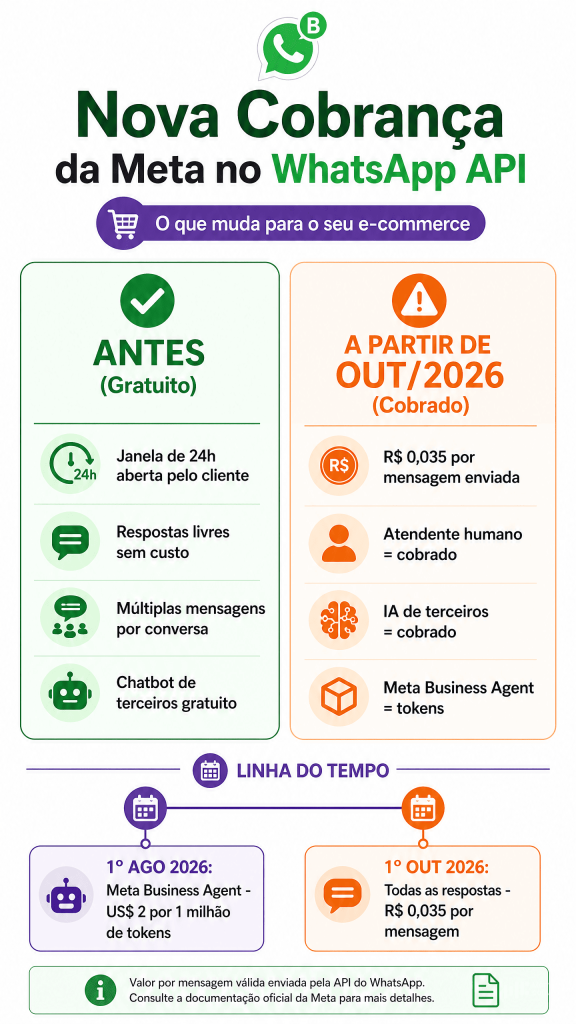
The Two Cost Models Starting October 2026
With this update, e-commerce businesses will have two primary paths to reply to their customers, each with a distinct pricing structure. Understanding this distinction is critical for making sound strategic decisions.
1. Human Support or ManyConvert AI
If the reply is sent by a human agent, chatbot, or non-Meta AI, each outbound message will cost US$ 0.04. In high-volume e-commerce operations, such as handling tracking queries, returns, and product details, the cumulative cost of these individual replies can add up quickly without an optimization strategy. For example, a conversation with 10 messages sent by the business will cost US$ 0.40. Multiplying this across 1,000 monthly interactions, the additional cost totals US$ 400.00 per month.
2. Meta Business Agent (Meta’s Proprietary AI)
To encourage the adoption of its proprietary artificial intelligence, Meta introduced the Meta Business Agent. Responses generated by this AI will be billed based on token consumption rather than individual messages. Pricing will be set at US$ 2 per 1 million tokens, effective August 1, 2026. Token usage varies based on interaction complexity: the more detailed the support conversation, the higher the token consumption.
| Response Model | Billing Start Date | Pricing Structure | Estimated Cost (Brazil) |
|---|---|---|---|
| Human Agent or Third-Party AI | October 1, 2026 | Per message sent | US$ 0.04 per message |
| Meta Business Agent (Meta AI) | August 1, 2026 | Per token consumed | US$ 2 per 1 million tokens |
Meta conducted a simulation for the Brazilian market: for 10,000 AI messages, the cost using Meta Business Agent in high-complexity interactions would range between US$ 400 and US$ 500. Using third-party AIs (with the added cost per service message), the same volume would cost US$ 968. In low-complexity conversations, the third-party AI cost would drop to US$ 268. Important note: for ManyConvert customers using our AI, the only costs will be our platform subscription and the additional message fee billed by Meta. In other words, for an online store averaging 1,000 monthly interactions, the additional cost will be US$ 400.00 per month. With conversational optimization strategies, this expense can be reduced considerably.
Exceptions to the New Rule: What Remains Free
Despite the new pricing model, cost exemptions apply in specific scenarios that your e-commerce should fully capitalize on:
“Click to WhatsApp” Ads: When a customer initiates a conversation via a Meta ad (on Facebook or Instagram) with a direct WhatsApp CTA button, messages exchanged over the following 72 hours remain free. This is a significant advantage for e-commerce businesses investing in paid acquisition to generate leads and sales.
Inbound Messages: Billing applies solely to replies sent by the business. Inbound messages received from customers remain free of charge.
The Direct Impact on E-commerce: Where Costs Will Rise
In online retail, WhatsApp has evolved well beyond basic support into a primary channel for customer engagement and revenue generation. The impact of the new pricing will be felt across three core areas that require operational focus:
Cart Recovery and Consultative Selling
Many e-commerce businesses use multi-step flows to recover abandoned carts or provide consultative sales, particularly in verticals such as fashion, home and furniture, or consumer electronics. If a shopper asks multiple product questions and an agent replies with several short messages, each reply will be billed. A recovery workflow that was once 100% free now carries variable costs tied directly to message volume.
Post-Purchase Support and Order Tracking
Questions regarding tracking updates, return policies, and delivery timelines often produce fragmented conversations. A poorly structured chatbot flow that forces customers through five or six confirmation steps before delivering an answer will incur five to six times higher costs than necessary. Flow efficiency is no longer just a UX metric; it is now a direct financial driver.
Repurchase and Engagement Campaigns
While the initial broadcast of a promotional campaign (marketing template) already has an established fee, subsequent interactions, when customers reply with questions or request details, will now incur an additional per-message cost. This underscores the need to build concise, informative broadcast copy that anticipates common questions.
How to Prepare Your Operation and Control Costs
This pricing adjustment is no reason to abandon WhatsApp, which continues to drive unmatched open and engagement rates in Brazil, active on 98.3% of Brazilian smartphones. The key to sustaining profitability lies in conversational efficiency: resolving more while sending fewer messages.
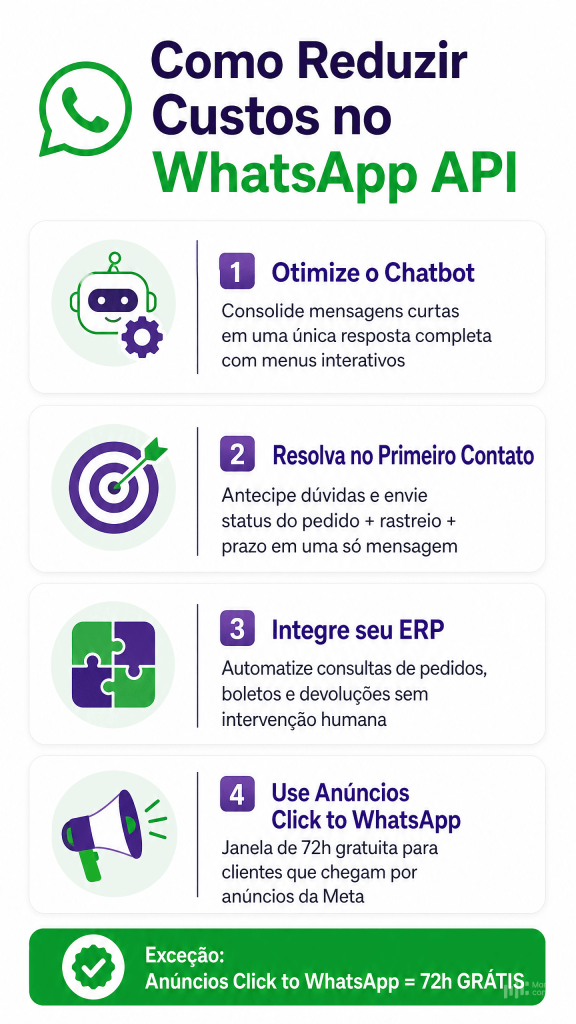
1. Optimize Chatbot Journeys
The habit of sending multiple short, fragmented messages has become financially inefficient. Review your automated bot flows to make them more concise. Instead of three separate messages (“Hi!”, “How can I help?”, “Choose an option:”), consolidate communication into a single, well-structured message using interactive menus and quick reply buttons. Every message saved protects US$ 0.04 in margin.
2. Prioritize First Contact Resolution (FCR)
Train your support reps and configure your automations to deliver comprehensive, actionable answers on the first touchpoint. When a shopper inquires about an order status, the reply should provide the current status, estimated delivery date, and tracking link together, anticipating follow-ups and eliminating redundant messages. A higher First Contact Resolution rate translates directly into lower support expenses.
3. Integrate Systems for Intelligent Automation
Connect your WhatsApp API to your ERP and e-commerce platform. When a customer requests a duplicate Boleto or order update, the system should pull the data automatically and return it in a single interaction, without requiring human routing or lengthy triage steps. Platforms offering native integrations with Shopify, VTEX, WooCommerce, and other major engines are essential in this environment.
4. Maximize Click to WhatsApp Ads
With the 72-hour free window for traffic arriving through Meta ads, e-commerce businesses running paid media possess a clear operational advantage. Align your performance campaigns on Facebook and Instagram to drive users to WhatsApp, ensuring primary conversion conversations take place entirely within this cost-free period.
5. Segment Campaigns with Precision
When executing marketing or re-engagement broadcasts on WhatsApp, apply segmentation filters strategically to reach audiences with high purchase intent. Segmenting by purchase history, average order value, purchase frequency, and recency ensures maximum ROI on your API spend, eliminating broadcasts sent to unengaged users.
ManyConvert: Efficiency and Profitability on WhatsApp
In this new pricing reality, the efficiency of your WhatsApp API stack will dictate your bottom line. ManyConvert was built to maximize e-commerce revenue by uniting intelligent automation with native integrations for leading online retail platforms.
With ManyConvert, you can recover abandoned carts, collect unpaid orders, send transactional alerts, and deliver streamlined customer service, minimizing the message count needed to close a deal or solve an inquiry. Our platform centralizes interactions, automates recurring workflows intelligently, and provides precision targeting filters for re-engagement campaigns.
Do not let Meta’s new rules cut into your margins. Speak with a ManyConvert specialist and see how to streamline your WhatsApp operations to drive higher revenue at lower costs.