



Imagine a personal shopping assistant that not only understands your needs, but also anticipates your wants, tirelessly researches the best options, negotiates prices, and completes purchases, all while you focus on other tasks. This is no longer science fiction. It is the world of agentic AI, and it is set to completely reshape the e-commerce landscape in 2026. For online store owners and marketing agencies, this transformation represents both a monumental opportunity and an existential challenge. Ignoring it means risking being left behind at breakneck speed.
Agentic commerce, powered by autonomous AI agents, is shifting the paradigm of how consumers interact with brands. The customer journey, once an active process of searching and clicking, is becoming a delegated, conversational experience. Statistics already point to this seismic shift: traffic to retail sites from AI platforms grew by more than 800% over the past year. This article takes a deep dive into the concept of agentic AI, explores how it is altering consumer behavior, and details what your e-commerce business must do to not only survive, but thrive in this new era.
What Is Agentic AI?
Agentic AI refers to artificial intelligence systems that can act autonomously on behalf of a user to achieve a specific goal. Unlike reactive chatbots that answer direct questions, AI agents are proactive. They can understand complex intent, break a task down into steps, execute those steps across multiple systems, and learn from the results to improve future performance.
In the context of e-commerce, an AI agent acts as a personal shopper. A consumer might simply say: “Find a birthday gift for my mom, who loves gardening, with a budget of $500. I need it delivered by Friday.” The AI agent then takes over:
- Research: Scours different online stores.
- Analysis: Compares products, reads reviews, checks seller reputation, and verifies product sustainability.
- Decision: Filters options based on user preferences and constraints.
- Action: Presents the top recommendations and, with user approval, completes the purchase.
This ability to execute complex tasks end-to-end is what makes agentic AI so revolutionary. It eliminates decision fatigue and search overload for consumers, delivering an unprecedented level of convenience and personalization.
How AI Agents Are Changing Buying Behavior
The rise of agentic AI is sparking a fundamental shift in consumer behavior, moving from manual browsing to intelligent delegation. The traditional buyer journey, characterized by opening multiple tabs, comparing prices in spreadsheets, and reading endless reviews, is becoming obsolete.
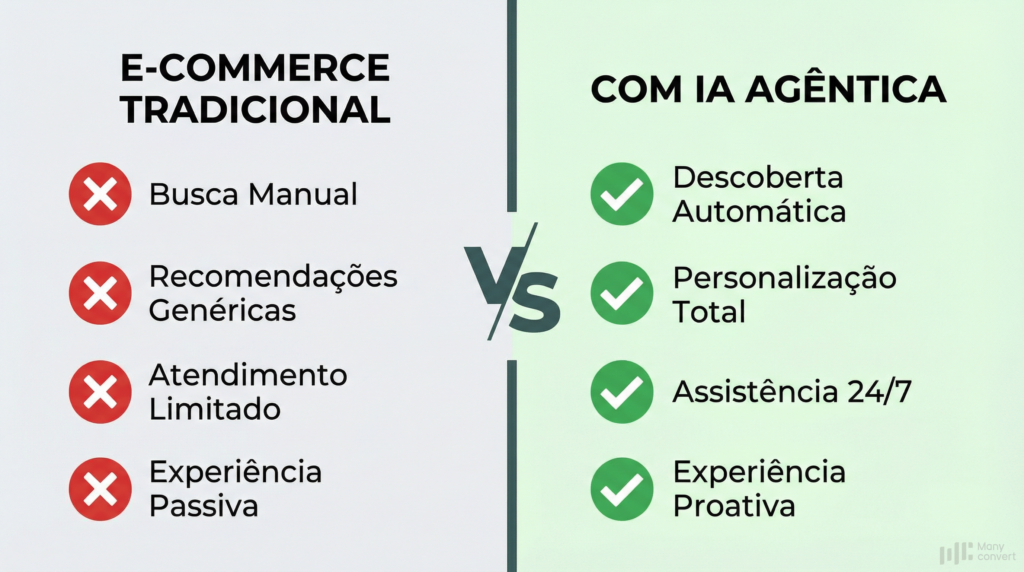
The new model is faster, more efficient, and centered on trust. Consumers are beginning to delegate the most tedious and time-consuming shopping tasks to their AI assistants. This is especially true for repeat or planning-based purchases, such as restocking groceries, buying gifts, or curating a new wardrobe.
“I think agentic AI will change behavior fastest in 2026 in the middle of the journey, around ‘help me figure it out,'” says Julie Towns, VP of Product Marketing at Pinterest. “You’ll see the biggest impact in repetitive, planning-driven decisions: clothing, rooms, gifts, seasonal updates, even weekly shopping.”
This shift means customer loyalty could move away from the brand or retailer toward the AI agent that consistently delivers the best recommendations. Trust in the agent becomes the most valuable asset.
Adoption Statistics and Data: The Revolution in Numbers
The transition to agentic commerce is not a distant forecast; the data already shows rapid adoption.
- Consumer Adoption: About 39% of consumers already use AI for product discovery, with that figure jumping to over half among Gen Z [1]. In addition, 23% of Americans reported buying something via AI in the past month [2].
- Traffic Growth: AI traffic to US retail sites saw an impressive 805% year-over-year increase during Black Friday 2025 [3].
- Market Projections: Projections indicate that agentic commerce volume could reach $5 trillion globally by 2030, according to McKinsey [4]. Morgan Stanley predicts AI agents will account for between $190 billion and $385 billion in US e-commerce spend by 2030 [2].
These figures paint a clear picture: agentic AI is not a passing trend, but a massive market force redefining the rules of the game.
The Impact on the Customer Journey
Agentic AI is compressing and reshaping the traditional customer journey (discovery, consideration, decision, purchase).
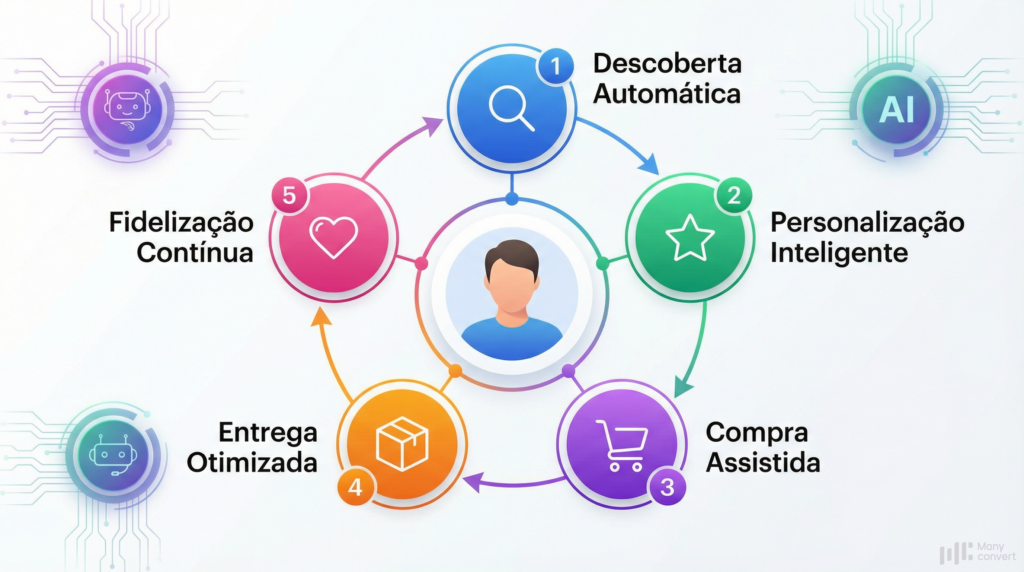
In the old model, retailers had multiple touchpoints to influence the customer. In the new model, most discovery and consideration happens “inside” the AI agent. The retailer only enters the picture at the moment of final recommendation. This has profound implications:
- The Battle for Relevance: Your brand’s visibility now depends on your ability to provide structured, high-quality product data that AI can understand and trust. SEO (Search Engine Optimization) is evolving into AEO (Answer Engine Optimization).
- The Window of Opportunity Shrinks: Purchase decisions happen faster. If your product is not in the agent’s first batch of recommendations, the opportunity may be lost for good.
- The Importance of Reputation: AI agents will analyze reviews, return policies, and your brand’s overall reputation. A poor online reputation can make you invisible to agents.
Trust and Transparency Challenges
Despite explosive growth, trust remains the biggest barrier to widespread adoption of agentic AI. Consumers are still cautious.
- Only 46% of buyers fully trust AI recommendations today.
- 89% still verify information before purchasing an AI-recommended product.
- 88% of shoppers want a clear source for recommendations, and 87% want verified reviews.
For e-commerce brands, this means transparency is essential. Being clear about why a product is recommended, offering easy access to authentic reviews, and maintaining fair, straightforward return policies and customer service will be more important than ever to earn the trust of both consumers and the AI agents representing them.
Practical Applications of Agentic AI in E-Commerce
Agentic AI is not a one-size-fits-all solution for every purchasing scenario. It excels in specific contexts where convenience, personalization, and efficiency are valued more than manual browsing and exploration.
Repeat Purchases and Automated Replenishment
One of the most promising use cases for agentic AI is automated replenishment for recurring consumer goods. Imagine a scenario where a consumer simply tells their AI assistant: “I’m running out of coffee, buy more.” The agent, recalling the user’s past preferences, identifies the brand and roast they usually buy, compares prices across multiple stores, chooses the best value with the fastest delivery, and completes the purchase, all within seconds. This capability is especially valuable for items like groceries, cleaning supplies, supplements, personal care products, and pet food.
Complex Purchase Planning
Agentic AI also shines in planning scenarios where consumers have a specific need but are unsure which product best fits it. For example, a customer might say: “I need a birthday gift for my 60-year-old mom who loves gardening, with a budget of $500.” The AI agent can evaluate preferences, budget, product reviews, and even sustainability ratings, delivering a curated list of recommendations for the customer to review and approve. This is especially useful for gift buying, home decor, occasion-specific apparel, and technical gear.
Product Discovery in Specialized Niches
For niche or specialized products where consumers may not know exactly what to look for, agentic AI can serve as a subject-matter expert. A photography enthusiast might ask: “Which lens is best for landscape photography with my Canon EOS R5?” The agent can analyze technical specs, compatibility, expert reviews, and pricing to deliver an informed recommendation. This democratizes access to specialized expertise and empowers consumers to make more confident buying decisions.
How E-Commerce Brands Should Prepare
The transition to an agentic AI-driven world won’t happen overnight, but the groundwork is being laid right now. E-commerce businesses that prepare today will be in a far better position to capture the coming wave of growth.
Invest in High-Quality Product Data
Your product data is the foundation of everything. Invest time and resources to ensure every product has detailed descriptions, high-resolution imagery, accurate inventory levels, and structured metadata. Consider partnering with an SEO/AEO specialist to optimize your product feeds so they can be seamlessly interpreted by AI algorithms.
Build and Manage Your Online Reputation
Your brand reputation will be a decisive factor in AI recommendations. Actively monitor reviews across all platforms, respond constructively to negative feedback, and encourage satisfied customers to leave verified reviews. A solid reputation is an invaluable asset in the AI era.
Automate and Optimize Customer Support
With purchases taking place through AI channels, post-sale customer support becomes even more vital for retention. Invest in automated customer service solutions that can quickly answer order inquiries, process returns, and resolve issues. Support efficiency directly impacts your reviews and, in turn, your AI recommendations.
Prepare Your E-Commerce for the Agentic Future with ManyConvert
The rise of agentic AI is a rising tide that will lift prepared businesses and sink the unprepared. Preparation doesn’t start in 2026; it starts right now. Your e-commerce data infrastructure, product data quality, and customer service strategy will dictate your success.
ManyConvert is your strategic partner in this transition. Our platform is designed to optimize and automate your e-commerce operations for the AI era.
- Intelligent Support Automation: Our AI agents handle the entire customer lifecycle, from lead qualification to post-purchase support, ensuring a consistent, frictionless experience that builds trust.
- Data Management and Personalization: Our platform lets you build granular customer segments and automated repeat-purchase campaigns, maximizing LTV.
- Integration and Efficiency: By centralizing customer support and automation, ManyConvert ensures your operation stays agile and ready to connect with emerging sales channels, like agentic commerce, while maintaining complete control over the customer experience.
The future of commerce is being written in AI code. Don’t be a bystander. Talk to a ManyConvert specialist and discover how we can equip your business with the intelligence and automation needed to lead the agentic commerce revolution.