


Have you ever stopped to think about how much effort and budget are required to acquire a new customer for your e-commerce store? Now, compare that to the cost of convincing someone who has already bought from you to purchase again. The difference is staggering. Industry benchmarks, such as those from Invesp, show that acquiring a new customer can cost up to 5 times more than retaining an existing one. Furthermore, returning customers tend to spend an average of 67% more than first-time buyers.
These numbers highlight a fundamental truth of e-commerce: your business’s true gold mine lies within your existing customer base. Yet, most e-commerce brands still treat every customer the same, blasting identical campaigns and offers to everyone. The result? Low engagement, missed opportunities, and revenue left on the table.
What if you could pinpoint, with surgical precision, who your best customers are, which ones are about to churn, and who needs a nudge to make their second purchase? That is exactly what RFM segmentation delivers. This powerful methodology transforms raw purchase data into actionable insights, enabling you to build personalized, relevant, and above all, profitable repurchase campaigns.
In this comprehensive guide, we will uncover all the secrets of RFM analysis and show you how to apply it to revolutionize your customer retention strategy.
What Is RFM Segmentation? The Triad of Customer Behavior
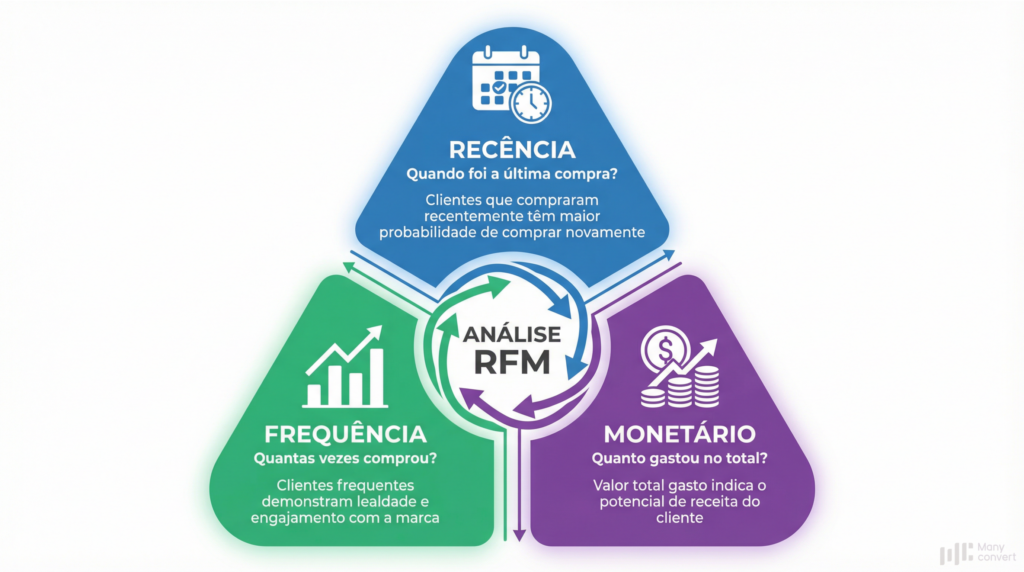
RFM stands for Recency, Frequency, and Monetary. It is a data analysis method used to identify and segment customers based on their purchasing behavior. Instead of relying on demographic data (such as age or location), RFM focuses on what customers actually do.
Let’s break down each of the three pillars:
1. Recency (R)
The core question: When was the last time the customer made a purchase?
This is the strongest indicator of customer engagement. A customer who bought last week is far more likely to buy again than someone who hasn’t purchased in six months. Recency helps you understand who has your brand top of mind and who might be slipping away.
2. Frequency (F)
The core question: How often does the customer buy?
This pillar measures brand loyalty. Customers who make repeated purchases, even with smaller order values, are exceptionally valuable. They display consistent engagement and are much more responsive to your campaigns. Frequency helps distinguish an occasional buyer from a true brand advocate.
3. Monetary (M)
The core question: How much total revenue has the customer generated?
Monetary value identifies your heavy spenders, the customers who drive the highest revenue. While a high-spending customer is critical, it is essential to evaluate this metric alongside Recency and Frequency. A customer who spent $5,000 two years ago and never returned is far less valuable than one who spends $200 every single month.
By combining these three factors, RFM analysis assigns a score to each customer, grouping them into specific segments with similar behaviors. That is where the magic happens.
The 7 Core Segments in ManyConvert
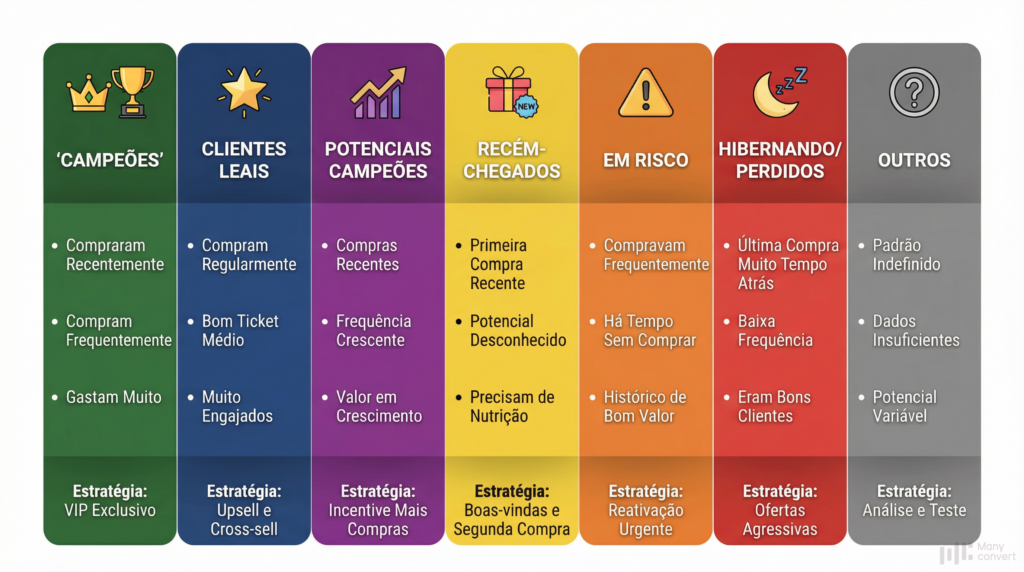
Based on Recency, Frequency, and Monetary scores, ManyConvert classifies customers into 7 primary segments, empowering you to deploy highly targeted strategies.
1. Champions
- Who they are: Your best customers. They purchased recently, buy frequently, and have a high spend.
- Strategy: Treat them like VIPs. Provide early access to new releases, exclusive gifts, private event invitations, and build a rewarding loyalty program. The goal is not just selling, but turning them into passionate brand ambassadors.
2. Loyal Customers
- Who they are: They buy regularly and deliver strong monetary value, though not quite at the Champions level.
- Strategy: Focus on upsells and cross-sells. Recommend complementary products, bundle offerings, and prompt them for product reviews. They already trust your brand; show them you understand their needs.
3. Potential Loyalists
- Who they are: Recent customers who have already purchased more than once and show promising potential.
- Strategy: Nurturing and engagement. Introduce a points-based loyalty program or a small perk for early repeat purchases. The goal is moving them into Loyal Customers or Champions.
4. New Customers
- Who they are: Made their first purchase recently. Their long-term potential is still unknown.
- Strategy: First impressions matter most. Send a welcome message, ask for feedback on their first order experience, and offer a clear incentive for their second purchase, such as a discount code or free shipping.
5. At Risk
- Who they are: Used to buy frequently and spent well, but haven’t made a purchase in a significant amount of time.
- Strategy: Urgent reactivation campaigns. Use an emotional angle like “We miss you!” paired with an irresistible offer. This is one of the most profitable segments to win back.
6. Hibernating/Lost
- Who they are: Last purchase was a long time ago with low purchase frequency. They were once viable customers, but are now inactive.
- Strategy: Time for aggressive win-back offers. Significant discounts, buy-one-get-one deals, or generous store credit. The priority is to re-engage them at any viable cost.
7. Others
- Who they are: Customers with undefined buying patterns or insufficient behavioral data.
- Strategy: Analyze and test. Use this cohort to test new messaging and offers, or simply monitor their activity until a clear pattern emerges.
High-Converting RFM WhatsApp Campaign Examples
To demonstrate the real-world impact of RFM segmentation, here are practical WhatsApp campaign templates you can deploy in your e-commerce store, leveraging ManyConvert’s 3D RFM intelligence to maximize performance.
Campaign 1: Win-Back for High-Value “At Risk” Customers
- Segment: “At Risk”
- 3D RFM Filter: “Qualify by High Value” (only customers with historically high spend)
- Objective: Re-engage high-LTV customers before they permanently churn.
Sample Copy:
“Hi, [Name]! We miss having you around! Since you are one of our most valued customers, we put together an exclusive gift just for you: 20% off our entire signature collection.
It’s our way of saying we would love to see you back! 😉
Tap here to claim your offer: [Link with auto-applied coupon]”
Why It Works:
- Laser-Focused Targeting: The campaign reaches only past high spenders, maximizing expected ROI.
- Direct Conversational Channel: WhatsApp ensures immediate, personalized message delivery with high open rates.
- Compelling Offer: A substantial discount (20%) is perceived as an exclusive, meaningful benefit.
- Personalized Tone: Friendly phrasing establishes genuine exclusivity (“one of our most valued customers”).
Campaign 2: Appreciation and Upsell for “Champions”
- Segment: “Champions”
- Objective: Reward loyalty and drive repeat sales with higher-ticket product lines.
Sample Copy:
“Hi, [Name]! 🌟 On behalf of our entire team, we want to thank you for being one of our top customers! To celebrate your loyalty, we are granting you VIP early access to our brand-new premium line.
Plus, with any purchase from the new collection, you will receive an exclusive complimentary gift!
Explore the collection here: [Link to new collection]”
Why It Works:
- Genuine Appreciation: Leading with gratitude strengthens brand equity and customer rapport.
- True Exclusivity: Granting early access creates high perceived value without discounting.
- Margin Protection: A complimentary gift preserves pricing integrity while boosting higher-margin items.
3D RFM: ManyConvert’s Competitive Edge to Scale Profitability
The examples above highlight why modern retention strategies must look beyond generic RFM segmentation. Standard tools display basic segments but lack a critical capability: filtering for high monetary value customers within each individual segment.
This is where ManyConvert breaks new ground with 3D RFM and our proprietary “Qualify by High Value” feature.
What Is 3D RFM?
Traditional RFM analysis operates mainly in 2D, plotting Recency and Frequency on a 2×2 grid while treating Monetary value merely as an aggregate average. ManyConvert’s 3D RFM treats Monetary value as a dedicated third dimension, letting you layer targeted monetary filters right over your behavioral segments.
This allows you, for instance, to isolate “At Risk” buyers and filter down to only those who historically generated significant revenue.
How Does the “Qualify by High Value” Filter Work?
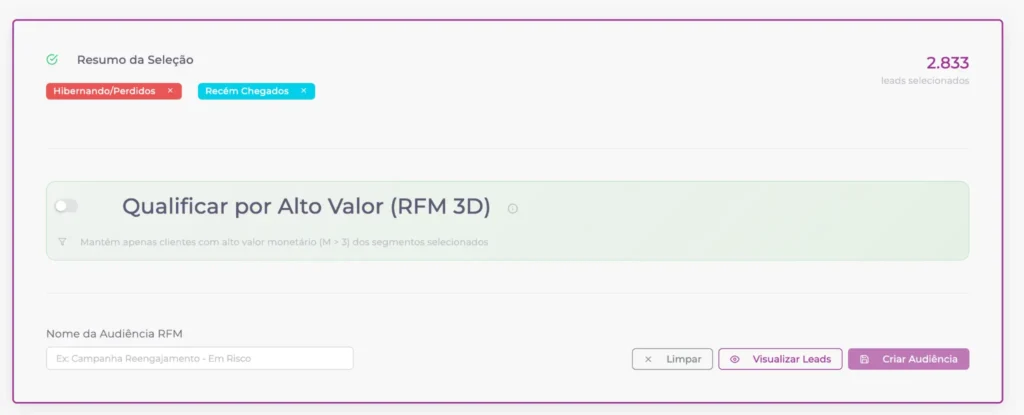
When creating an audience in ManyConvert, you can choose multiple RFM segments (such as “Hibernating/Lost” and “At Risk”). By enabling the “Qualify by High Value (3D RFM)” filter, the platform applies a decisive rule: it keeps only profiles whose Monetary score (M) is above 3 (on a 1-to-5 scale).
In practice, you are directing the system to:
“I want to win back my at-risk and inactive accounts, but I want to spend my marketing budget and my best offers only on buyers who previously demonstrated high purchasing power.”
Why This Is a Game-Changer
- Maximizes Marketing ROI: Instead of giving steep discounts to low-ticket buyers, you focus spend and aggressive incentives on high-LTV cohorts.
- Smarter Campaigns: Deploy split campaigns for the “At Risk” segment: a baseline offer for the general audience and a high-incentive, personalized flow for top spenders.
- Lowers Reactivation Costs: Avoids wasting margin on buyers with low LTV potential, even when reactivation succeeds.
Conclusion: Turn Data into Revenue with RFM and ManyConvert
RFM segmentation goes beyond tactical marketing; it transforms how you understand and engage your entire customer database. It marks the shift from mass outbound blasts to surgical precision marketing, ensuring every buyer receives communication tailored to their real buying behavior.
By moving past uniform messaging and personalizing campaigns across Recency, Frequency, and Monetary scores, you increase repurchase rates, boost average order value (AOV), and nurture lasting customer relationships.
With advanced capabilities like ManyConvert’s 3D RFM filter, you take this strategy even further, directing your best resources toward the accounts that move the needle on your bottom line.
Ready to stop wasting spend on generic blasts and start generating revenue with customer intelligence?