


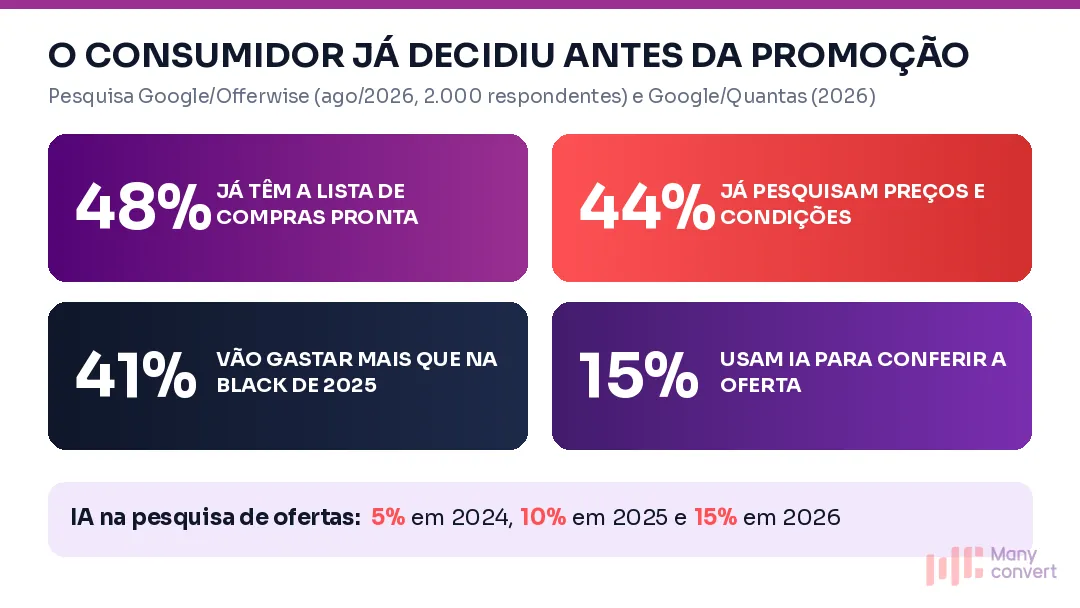
There are 45 days left until Black Friday 2026, scheduled for November 27, and a large portion of your audience has already decided what to buy. A Google survey commissioned from Offerwise and released in August showed that 48% of Brazilian consumers already had their shopping lists ready, 44% were researching prices, and 46.7% were organizing their finances for the date. All of this happened two months before the sales event, not during the week of the event.
Those who leave Black Friday preparations for the last week will be competing for a decision that has already been made. They will pay more for the same click, compete against the highest concentration of ads all year, and engage a consumer who arrives with a benchmark price in hand. It is the opposite of what it seems: the loudest date on the retail calendar is the one that demands the most discipline and an owned customer base.
This guide delivers a six-week plan to reach November 27 with healthy margins and explains why WhatsApp costs changed on October 1, 2026.
Black Friday 2026 Will Be the Black Friday of Planning
Google itself dubbed this year’s edition the “Planning Black Friday.” The behavior recorded in the August survey confirms the moniker: nearly half of respondents intend to buy during the event, compared to 61% in 2025. It might seem like fewer people, but they are much more decisive buyers.
When consumers plan ahead, they change the playbook. They do not browse on impulse: they compare, track, and wait. And they already know where they will buy. Thirty percent of respondents said they chose their preferred retailer even before the promotions began.
The adoption of artificial intelligence in the purchasing journey is the metric that has shifted the most since 2024. 15% of consumers plan to use AI tools to research products, track prices, and assess whether a deal is truly worth it. Back in 2024, that figure was 5%, rising to 10% in 2025. The growth trajectory is what matters: it tripled in two years.
“In a year with tighter competition for wallet share, Brazilian consumers shape their habits around their greatest asset: the savvy to track down the best deal.” — Gleidys Salvanha, Director of Retail and Technology at Google Brazil, 2026
The practical implication is harsh for brands that only show up on the day. Brazilian e-commerce generated US$ 235.5 billion in 2025, a 15.3% increase over 2024 according to Abiacom, while ABComm projects over US$ 258 billion in 2026. For Black Friday, Abiacom projects US$ 14.7 billion in sales, with an average order value of US$ 808.50. The pie is growing, but consumers decide well in advance who gets their slice.
Why Your Owned Audience Is Worth More Than New Customers in November
There is an incentive that drives purchasing decisions, and it is not just price. In another Google survey conducted by Quantas with 4,000 Brazilian consumers, 81% of purchases are driven by some incentive: discounts, free shipping, coupons, or cashback. Among respondents, 80% report looking for Black Friday discounts, 73% enjoy hunting for deals, and 72% follow promotions regularly.
If everyone offers incentives, discounts cease to be a differentiator. What sets you apart is who gets the offer first, on the channel they actually read.
During Black Friday week, ad costs spike because every competitor enters the same auction. Reaching people who have already bought from you costs a single message, not an ad auction bid. It is the difference between paying to interrupt and simply being remembered.
| Workstream | Typical Cost | When It Yields Results | Risk During Event |
|---|---|---|---|
| New acquisition traffic for the sale | Highest auction cost of the year | On the day of the event | High: if the click does not convert, ad spend is lost |
| Owned audience activated with context | One message per contact | Weeks ahead, during intent capture | Medium: depends on segmentation and opt-in status |
| Cart and order recovery | One message per contact | When the cart is abandoned | Low: high purchase intent already exists |
The data supporting the final row is familiar to anyone running e-commerce: the global average cart abandonment rate is 70.22%, according to the Baymard Institute across 50 aggregated studies. Seven out of ten carts stall before checkout. On Black Friday, this gets worse as shoppers fill carts, compare options in another browser tab, and deliberate carefully. If your store does not have an automated workflow in place yet, start with our guide to cart recovery with WhatsApp.
The New WhatsApp Pricing Dynamic on Black Friday
November planning comes with a new cost variable. As of October 1, 2026, service messages sent via the WhatsApp Official API are billed per delivered message. A service message is any free-form text response your store sends within the 24-hour customer service window, whether written by an agent or automated by a chatbot. Previously, it was free.
The same rule applies to utility templates sent while a 24-hour window is active, such as order confirmations and shipping updates, which previously incurred no extra charge. We detailed what changes across categories in our post on the new WhatsApp API pricing. The service fee in Brazil is US$ 0.035 per message, matching the rate charged for utility and authentication templates according to Meta’s pricing card for Brazil.
Three key details mitigate costs and should be included in your plan. The free tier of 1,000 service messages per month per number remains free, renewed monthly without rollover. The 72-hour window for Click-to-WhatsApp ads remains exempt from delivery charges, making lead capture campaigns significantly more cost-effective than cold broadcast messaging. And the mobile WhatsApp Business app is excluded from this pricing: the rule applies specifically to the Official API.
The impact on your budget is immediate: if your team replies across five message bubbles when one would suffice, you pay five times. In November, as message volumes surge, this inefficiency turns into an unforeseen budget drain. Responding clearly, concisely, and with complete context is no longer just a quality standard; it is a direct driver of margin preservation.
The 6-Week Plan to Hit November 27 Prepared
The six weeks between now and Black Friday provide ample time, provided each week has a dedicated deliverable. The sequence below matters because each step builds directly on the previous one.
- Week 1, through October 16: Clean your database. Segment users who purchased within the last 6 months, abandoned carts within the last 90 days, and those who have not opened a message in over 120 days. Bad segmentation guarantees wasted spend in November.
- Week 2, through October 23: Confirm opt-ins. Meta’s opt-in rules govern marketing campaigns and protect your phone number from getting blocked. Reactivate your list with verified consent and prune unsubscribed contacts.
- Week 3, through October 30: Structure offers by audience segment. Recent buyers respond to early access and VIP gifts. Cart abandoners convert with reminders and social proof. Blasting the same promotion to everyone is the fastest way to bleed margin.
- Week 4, through November 6: Draft and submit templates for approval. Template approvals are not instant, and review queues back up as the holiday approaches. Submit utility templates for orders, payments, and shipping, along with marketing templates for your core offers.
- Week 5, through November 13: Test at small scale. Run the end-to-end workflow on a 5% sample segment, measuring response rates per conversation and abandoned cart conversion. Refine copy before scaling up.
- Week 6, through November 20: Finalize operational readiness. Set customer support shifts, quick replies, automated tracking alerts, and assign a dedicated team member to monitor abandoned carts throughout the early hours of Friday.
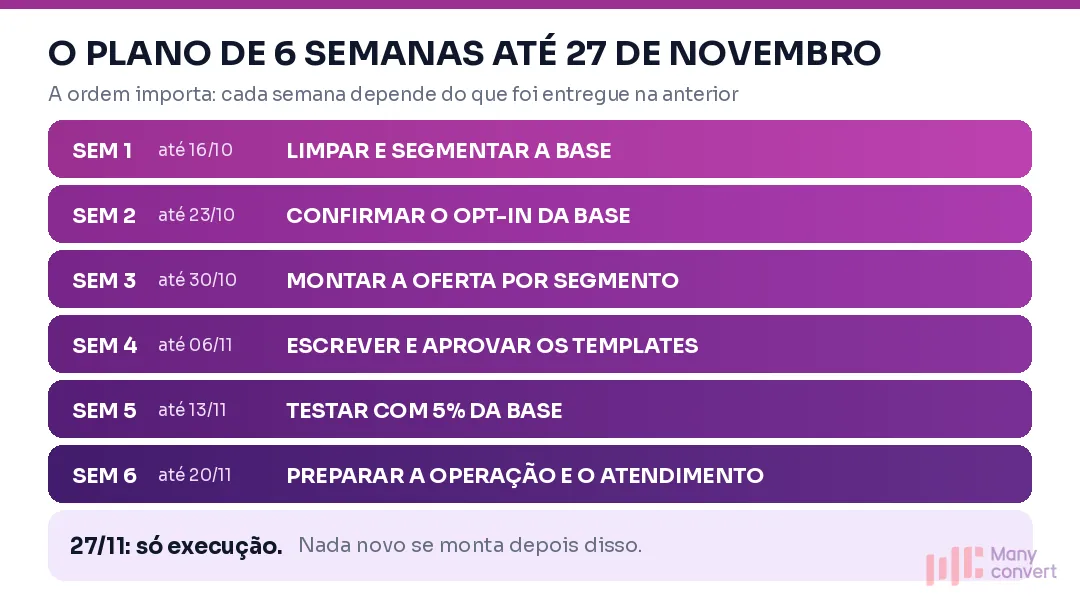
That leaves Black Friday week itself and Cyber Monday. Those days are strictly for executing validated workflows, not building new ones.
The 5 Mistakes That Turn Black Friday Into a Loss
Most margin losses in November stem from unprepared operations, not flawed pricing. The five mistakes below appear consistently across stores that generate GMV spikes without retaining healthy margins.
- Discounting for shoppers who were already going to buy. If a customer was ready to purchase, a coupon simply reduces gross revenue. Use incentives to unlock hesitation, not to reward shoppers already at checkout.
- Blasting the entire contact list. High volume without segmentation drives up your messaging invoice, triggers blocks, and tanks phone number quality ratings right when you need deliverability most.
- Leaving abandoned carts without an automated sequence. With an average abandonment rate of 70.22%, every hour without automated recovery leaves cash stranded in abandoned sessions.
- Replying across seven separate bubbles. Every outbound message is billable. A support flow resolving inquiries in a single well-structured message costs a fraction of sending multiple fragmented replies like “hi”, “how can I help?”, and “let me check”.
- Overpromising delivery timelines. Orders spike dramatically over a few days. If the delivery window communicated over WhatsApp diverges from actual inventory and logistics capacity, delays turn into chargebacks and disputes.
How to Measure If the Event Was Truly Profitable
Revenue alone is misleading in November. Four core metrics reveal the real operational outcome:
- Contribution margin by channel: revenue minus discounts and messaging costs. Without this, you cannot know whether Black Friday funded sustainable growth or merely strained your team.
- Cart recovery conversion rate: the percentage of recovered carts that converted into paid orders. This confirms whether your recovery messaging resonates.
- Messages per resolution: how many outbound messages your store sends to resolve a customer inquiry. Under current pricing, this directly affects operational costs.
- 60-day repeat purchase rate: how many Black Friday buyers returned without requiring another steep discount. This separates events that build customer equity from those that merely clear inventory.
If these four metrics are tracked before November, you know exactly what levers to adjust the following week. Without them, clarity only arrives in January when the financial damage is already done.
Conclusion: Black Friday Is Won in the Weeks Leading Up to It
The 2026 consumer arrives on November 27 with a prepared wishlist, benchmark pricing, and AI checking whether your deal is genuine. Faced with this buyer, last-minute discounts fall flat. What determines success is what your team executes right now: a segmented customer base, verified opt-ins, approved templates, active cart recovery flows, and message costs under control.
With ManyConvert, you recover abandoned carts, follow up on unpaid orders, engage shoppers with targeted notifications, and deliver personalized customer service on WhatsApp with AI agents and human teams working on the same number. The platform segments your audience, triggers behavioral repurchase sequences, and tracks conversion across every step, ensuring you arrive on November 27 with operations optimized and messaging costs under control.
Schedule a ManyConvert demo and lock in your Black Friday strategy before competitors finalize theirs.