



In April 2026, 142 million Brazilians made at least one Pix transaction, equivalent to 93% of the adult population, according to Central Bank data presented in an FGV Direito Rio webinar. Pix became the country’s default payment method and created a type of abandonment almost nobody tracks: an order that already exists in your system, with reserved inventory, that was never paid for.
Abandoned carts have dashboards, benchmarks, and blog posts. Generated yet unpaid orders do not even have a name in your reports. They show up as “awaiting payment” and vanish. Yet from a cash flow perspective, both carry similar costs: paid acquisition costs, locked inventory, and lost revenue.
This article breaks down why Pix and Boleto fail for different reasons, the real recovery window for each, the four-message sequence you should deploy today, and how the Central Bank’s hybrid billing changes the game starting in 2027.
The Abandonment Missing from Your Reports
The industry benchmark comes from the Baymard Institute: 70.22% average cart abandonment, calculated across 50 studies. The number is reliable, but it bundles very different issues together. When Baymard breaks down the reasons, they find 40% due to extra costs (shipping, fees), 19% due to trust issues entering credit card details, 18% due to mandatory account creation, 17% due to a long checkout process, 17% due to website errors, 10% due to declined cards, and 9% because the preferred payment method was unavailable.
Look closely at the last two. In those cases, the customer reached the finish line, picked how to pay, and got stuck. There is no question about purchase intent: there is a pending order.
In practice, your checkout produces three states, and you probably treat all three the exact same way:
Cart is when no final decision has been made yet. Unpaid order is when the customer decided, generated the payment instrument, and did not pay. Payment under review is when they paid, but the transaction was flagged by anti-fraud rules or identity verification.
Each state requires a different message at a different cadence. Chasing all three with the exact same copy is where the problem starts.
Why Pix and Boleto Abandonments Happen Differently
Pix is instantaneous, and that urgency is precisely what creates the drop-off. The QR code expires, the customer switches apps to check their balance, the bank enforces limits, or an anti-fraud block halts the transaction. When they return, the code is expired. On your end, the order stays open, inventory remains reserved, waiting on a payment that never clears.
Boleto fails along a different path. The due date is measured in days, not minutes. The customer generates it, closes the browser tab, and plans to pay later. Between generation and expiration, they compare prices, get distracted by other emails, and forget. In most cases, it is not an intentional drop-off; it is daily friction.
Using the same recovery flow for both channels wastes money. Here are the differences that matter:
| Dimension | Pix | Boleto |
|---|---|---|
| Payment window | minutes, until the QR code expires | 1 to 3 business days until due date |
| Primary drop-off causes | app switching, transfer limits, anti-fraud triggers | forgetting and price comparison |
| Intent signal | high: customer opened their banking app | medium: generated today to pay later |
| Inventory risk | low, resolves within minutes | high, ties up inventory for days |
| Most common mistake | messaging after the code has expired | sending the Boleto PDF via WhatsApp |
| Effective approach | short reminder with a fresh payment code | date-specific reminder with payment link and due date |
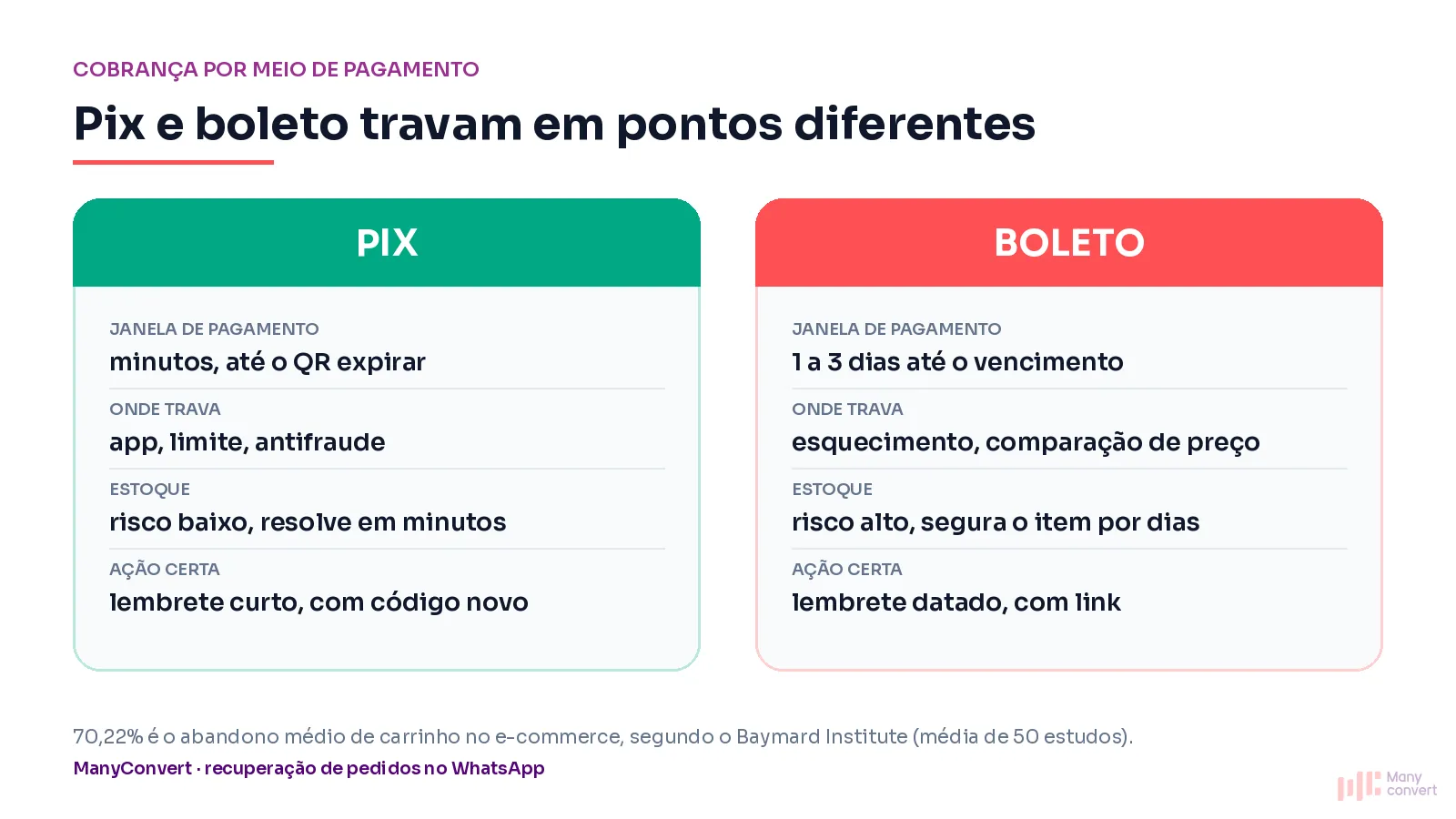
If you use the same template for both, your Pix customer receives a message talking about a due date days away, while the Boleto customer gets generic copy that mentions no due date at all. In both cases, the message lacks the exact detail needed to complete the purchase.
The True Cost of Orders Stuck in Limbo
Customer acquisition cost is already sunk once the order is placed. If you invest US$ 80 to acquire a buyer and 1 in 5 orders goes unpaid, your monthly figures will not match what the dashboard projects: the unpaid order eats into the profit margins of the four that did convert.
There is more. Reserved inventory does not return to available stock on its own. In November, this penalty doubles: with Black Friday falling on November 27, 2026, every unit locked in an unpaid order is an item another customer cannot purchase during peak demand. Moreover, shipping rates quoted at checkout often change if the order is paid three days later.
The third cost never appears on a spreadsheet. Customers who generated a Pix and failed to pay frequently return asking, “Where is my order?”. Support teams spend valuable time explaining that payment was never confirmed, creating immediate friction for both sides.
The 4-Message Flow to Recover Unpaid Orders
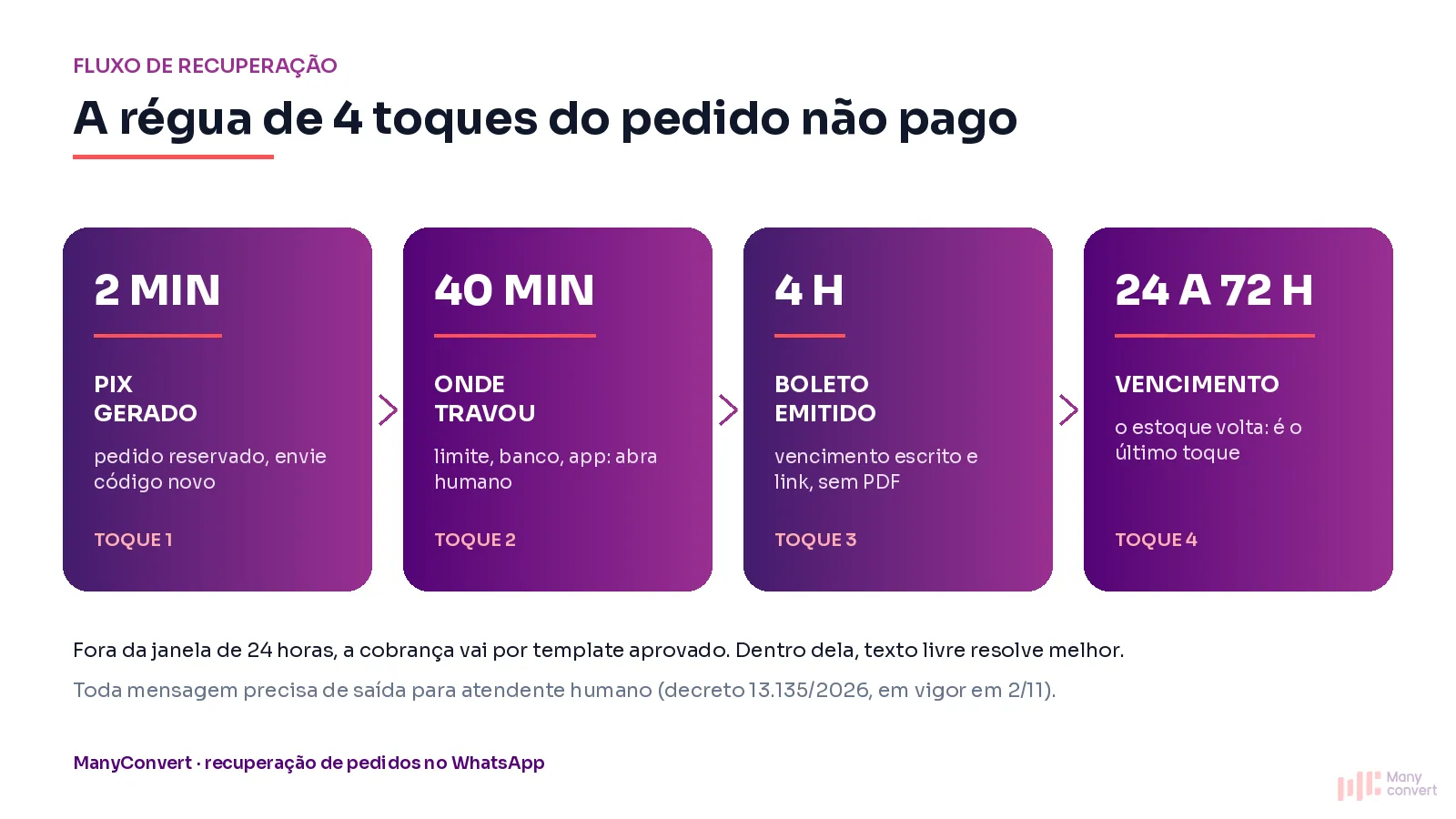
This cadence relies on smart timing and concise messaging, not spam. If your issue begins earlier with carts that never became orders, our multichannel cart recovery guide covers that stage.
- Two minutes after generation for Pix: notify that the items are reserved and send a fresh payment code. No aggressive tone, no mention of debt. The customer simply needs an easy way to finish what they started.
- Forty minutes: ask what went wrong. Bank limits, app failure, or shipping questions? This is where a human handoff shines, as replies are usually specific: the bank blocked the transfer, the banking app crashed, or they were US$ 20 short on their daily limit.
- Four hours for Boleto: a reminder with the explicit due date written out and a direct payment link. Do not attach a PDF. On mobile, downloading a Boleto PDF causes unnecessary friction.
- At due date, between 24 and 72 hours: the final touchpoint, sharing critical context the customer lacks: inventory hold limits. If you offer alternatives (discounted Pix, installments), do so only after tracking baseline data. Offering immediate discounts simply trains customers to wait for price drops.
Two operational rules: outside the 24-hour messaging window, communications require an approved template; inside it, you can respond with freeform text. Furthermore, every recovery sequence must feature a visible human handoff option, as Decree 13,135/2026, taking effect on November 2, requires businesses to provide real-time access to a human agent.
How Hybrid Billing Changes Recovery Starting in 2027
On September 18, 2026, the Central Bank published Resolution 587, updating Pix across several areas. Two directly impact billing operations: hybrid billing, scheduled to take effect on February 1, 2027, and new rules for static QR codes starting July 1, 2027. In practice, hybrid billing allows a Boleto to be settled via Pix, significantly shrinking the window between order placement and cash collection.
Automatic Pix already demonstrates the scale of these gains. Itaú reported a 281% increase in financial volume processed through Automatic Pix billing during the first half of 2026 compared to the second half of 2025, noting roughly 90% settlement efficiency, with an improvement of over 20 percentage points in payment fulfillment.
“payment methods evolved from an experimental initiative into a proven efficiency driver for receivables collection” – Itaú, September 2026
For merchants, the takeaway is clear: payment recovery is no longer just a back-office financial detail; it is an integral part of the buyer journey. Ahead of February 2027, sync with your payment gateway to ensure your checkout infrastructure supports hybrid billing.
5 Mistakes That Turn Recovery Messages into User Blocks
- Messaging at minute zero like a collection agency. A shopper who generated a Pix 60 seconds ago is likely still typing their banking password.
- Sending Boleto as a PDF. Clunky files are illegible on mobile devices and lack direct payment links. Use web links and QR codes.
- Omitting inventory expiration deadlines. Limited hold times are the only compelling trigger for shoppers whose intent cooled off.
- Following up after payment is settled. Lagging integrations send recovery prompts to paying customers, ruining your sender reputation and brand trust.
- Automating without a human handoff. Bots looping generic “please wait” replies trigger public complaints and, starting in November, regulatory compliance risks.
How to Measure If Order Recovery Is Working
Recovered revenue is the ultimate metric, but it conceals the operational diagnosis. Track these five indicators, keeping Pix and Boleto metrics segmented:
- 24-hour payment conversion rate, broken down by payment method.
- Average time between order generation and payment confirmation.
- Recovered revenue per 1,000 generated orders, normalizing for volume fluctuations.
- Block and opt-out rates across recovery messaging.
- Cost per recovery conversation relative to order margin.
Without segmenting by payment method, Boleto will always look inefficient because of its naturally longer cycle. And without weekly cohort analysis, you cannot pinpoint whether drop-offs stem from checkout friction rather than messaging.
Conclusion: Unpaid Orders Are Revenue Trapped in Limbo
Pix has reached 142 million Brazilians, introducing an abandonment pattern invisible in standard marketing dashboards. Expired Boleto slips, timed-out Pix codes, and pending reviews represent lost revenue that does not require new acquisition campaigns to fix. It requires targeted recovery at the right moment, directly where the customer already is.
ManyConvert recovers abandoned carts and unpaid orders via WhatsApp, with tailored messaging per payment method and full conversational history so live agents can step in the moment a customer replies. If you want this workflow live before November 27, speak with a specialist.