



Your E-commerce Sales Graveyard
Imagine a graveyard. Now, instead of tombstones, picture digital shopping carts, packed with products, abandoned and forgotten. This grim image is the daily reality for most e-commerce businesses. Data from the Baymard Institute shows that the average cart abandonment rate in 2026 hovers around 70-77% [1]. This means that for every 10 customers who add items to their cart, 7 or 8 drop off before completing their purchase.
These are not just numbers; they represent a revenue hemorrhage. That represents thousands, or even millions, of dollars in potential sales evaporating every single day. For years, the only solution was a timid email sequence, which today struggles to reach a 20% open rate, with click-through rates rarely topping 5%. In 2026, relying solely on email to recover abandoned carts is like trying to put out a fire with a glass of water.
What if you could rescue a significant portion of this lost revenue? What if, instead of an email monologue, you could start an instant, personal conversation with the customer the exact moment they hesitate? The revolution in cart recovery does not lie in a new email template, but in an intelligent multichannel strategy, orchestrated by Artificial Intelligence and led by the world’s most powerful communication channel: WhatsApp.
In this guide, we break down the anatomy of a cutting-edge recovery strategy that combines the immediacy of WhatsApp, the formality of email, and the intelligence of AI to recover up to 30% of your lost sales.
Why Do Customers Drop Off? Understanding the Psychology of Cart Abandonment
Before crafting a solution, it is crucial to understand the problem. Cart abandonment is rarely a final decision. Most of the time, it is a symptom of hesitation, doubt, or interruption. Understanding the core reasons is the first step toward tackling them effectively.
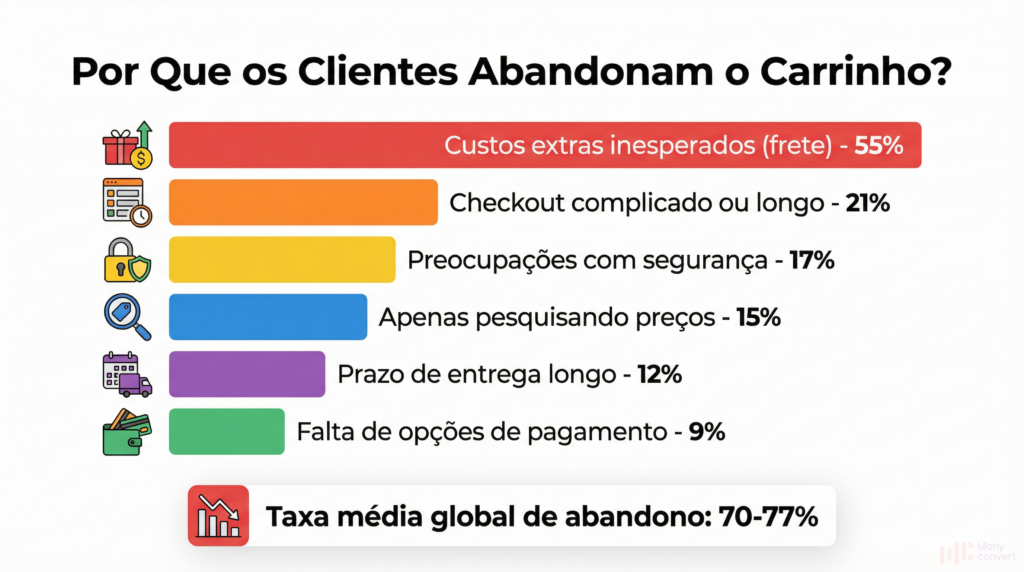
According to market research [1][2], the primary culprits are:
- Unexpected Extra Costs (55%): Shoppers are caught off guard by high shipping fees or taxes at checkout.
- Complicated or Long Checkout (21%): Having to create an account or fill out too many fields creates friction and frustration.
- Security Concerns (17%): The website does not look trustworthy enough to enter credit card details.
- Just Browsing (15%): The shopper was merely comparing prices and had no real intent to buy right then.
- Slow Delivery Times (12%): The estimated delivery time is too slow compared to competitors.
An effective recovery strategy does not just remind shoppers about their cart; it directly addresses these objections in a proactive, conversational way.
The Multichannel Recovery Sequence: Timing Is Everything
A single message is never enough. Effective recovery relies on a sequence of touchpoints across different channels with precise timing. The goal is to be helpful, not pushy. Here is a battle-tested sequence that balances persistence and common sense.
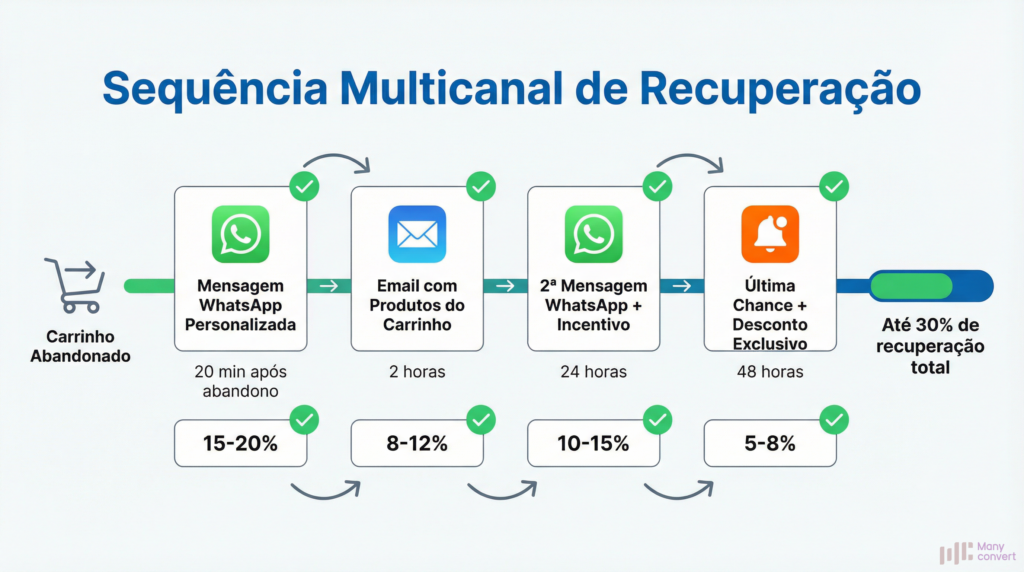
Stage 1: The Immediate Outreach (20 Minutes After Abandonment)
- Channel: WhatsApp
- Goal: Act while buying intent is still hot.
- Sample Message: “Hi, [First Name]! 😊 I noticed you left some amazing items in your cart. Did something go wrong, or do you have any questions I can help resolve?”
- Why it works: WhatsApp’s 98% open rate ensures your message gets seen. The tone is consultative rather than aggressive. You position yourself as a helpful guide, not a desperate salesperson. This first message alone can recover between 15% and 20% of abandoned carts [3].
Stage 2: The Formal Reminder (2 Hours After Abandonment)
- Channel: Email
- Goal: Provide a formal, visual reminder that shoppers can save for later.
- Content: A well-designed email showcasing images of the abandoned items, a catchy subject line like “Did you leave something behind?”, and a clear CTA button to “Complete Your Purchase.”
- Why it works: Email acts as a tangible record. Even if not opened immediately, it stays in the customer’s inbox. This stage can deliver an additional 8-12% in recovered carts.
Stage 3: The Smart Incentive (24 Hours After Abandonment)
- Channel: WhatsApp
- Goal: Overcome the price barrier (the top reason for abandonment) with a smart offer.
- Sample Message: “Hi, [First Name]! I noticed you haven’t finished your order yet. To help you decide, here is a free shipping coupon for your cart. It’s only valid for the next 24 hours! 😉 Cart link: [Link]”
- Why it works: Offering free shipping directly removes the biggest friction point. The 24-hour urgency creates a strong psychological trigger to take action. This stage can reclaim an additional 10-15% of shoppers.
Stage 4: The Last Call (48 Hours After Abandonment)
- Channel: Email or Push Notification
- Goal: Create a final sense of urgency and value.
- Content: “LAST CHANCE, [First Name]! Your cart expires in 3 hours. Use coupon code VOLTA10 to get an extra 10% off when you complete your purchase right now.”
- Why it works: This is the final touchpoint, targeted at price-sensitive customers. A percentage discount provides a strong incentive. This final stage can add another 5-8% to your overall recovery rate.
Adding up the potential of each stage, this multichannel playbook can realistically recover between 25% and 30% of revenue that would otherwise be permanently lost.
WhatsApp vs. Email: Why WhatsApp Leads Cart Recovery in 2026
For years, email was the go-to channel for cart recovery. While it still holds value in the mix, data demonstrates that WhatsApp is drastically more effective as the primary touchpoint.
The difference begins with open rates. While cart abandonment emails average a 40-45% open rate (already higher than general email benchmarks), WhatsApp messages achieve a staggering 98% open rate, typically within the first 3 minutes of delivery [3]. That means your recovery message doesn’t just arrive — it gets seen almost instantly.
Furthermore, WhatsApp enables two-way interaction. If a customer replies to an email with a question, getting an answer can take hours or even days. On WhatsApp, the conversation is instantaneous. A shopper can ask, “Does this item come in black?” and receive a response in seconds, whether from a live agent or conversational AI. This ability to resolve objections in real time is what makes WhatsApp such a powerful recovery engine.
Another crucial element is contextual personalization. On WhatsApp, you can dispatch messages featuring the shopper’s name, their specific cart items, and even product pictures, all formatted like a personal 1:1 chat instead of a generic marketing blast.
The 5 Fatal Mistakes in Abandoned Cart Recovery
Before rolling out your strategy, watch out for these common pitfalls that can derail your results:
Mistake 1: Waiting Too Long to Take Action
Timing is everything. Studies show that recovery rates plummet after the first hour. If you wait 24 hours to trigger your first message, you have already missed the golden window. Your initial outreach should happen within 20 minutes.
Mistake 2: Being Too Generic
Messages like “You left something in your cart” that fail to mention specific items are easily ignored. Personalize every outreach with the customer’s name and the exact items left behind.
Mistake 3: Offering Discounts Right Away
If you offer a discount in the very first message, you train customers to abandon their carts intentionally just to score a deal. Save financial incentives for the third or fourth touchpoint in your sequence.
Mistake 4: Missing the Real Objection
If a customer left because of high shipping fees, a 5% product discount will not solve the issue. Unpack the underlying drop-off triggers and craft specific answers for each objection.
Mistake 5: Pushing Beyond the Limit
Sending 10 recovery messages isn’t persistence; it’s spam. Cap your sequence at 3-4 touchpoints over 48 hours. If the customer hasn’t converted by then, respect their decision and route them to a long-term nurture workflow.
The Role of AI in Orchestrating Cart Recovery
Managing this sequence manually for thousands of customers is impossible. This is where Artificial Intelligence takes center stage. An AI-powered automation platform like ManyConvert can orchestrate this entire workflow autonomously.
- Abandonment Detection: The platform detects cart drop-offs in real time.
- Automated Triggers: AI launches the multichannel sequence automatically, delivering the right message on the right channel at the right time.
- Smart Replies: If a customer replies on WhatsApp with an inquiry (“Do you ship to my area?”), AI understands and replies instantly, or seamlessly escalates to a human agent for complex questions.
- Data Analytics: The platform tracks which stages and copy variations drive the highest recovery, empowering you to optimize continuously.
ManyConvert: Your Command Center for Sales Recovery
Stop leaving money on the table. Turn your e-commerce cart graveyard into a goldmine of recovered revenue. With ManyConvert, you gain the technology needed to execute a next-gen cart recovery engine.
- Multichannel Automation: Build and manage recovery sequences that combine the strength of WhatsApp and email.
- Conversational AI: Deploy smart chatbots to interact with shoppers 1:1 and resolve questions in real time.
- Unified Customer View: Access complete conversation histories in one place, empowering your team to provide contextual, high-impact support.
Stopping sales leaks from abandoned carts is no longer optional; it is essential for survival and profitability in 2026 e-commerce.
Ready to stop burning revenue and start recovering lost sales? Discover how ManyConvert can automate your abandoned cart recovery and boost conversion. Talk to an expert today!