


With 11 days left until Black Friday on November 27, your WhatsApp is ready: template approved, list segmented, coupon configured. Except the message coming out of this flow has an 81.5% chance of never getting a reply. A Blip study released on October 19, 2026, covering 6 million messages from 4,000 companies, measured an open rate of 69.5% and a response rate of 18.5%. High open rates, almost no conversation.
On Black Friday, this hurts even more. In 2025, OmniChat tracked 15 million conversations between sales reps and consumers during the event, up 31% year-over-year. Consumers are willing to talk. What they don’t do is reply to broadcast alerts.
This article breaks down what the 2026 data reveals about how retail actually uses WhatsApp, why message format determines whether customers reply, and which flows you can still set up before November 27.
Your Store’s WhatsApp Has Become an SMS with a Link
The Blip study, based on 2025 data across a sample of 4,000 businesses, revealed an uncomfortable pattern. 99% of messages focus on just two use cases: order or service updates, and follow-ups. And 98% are one-way blasts sending a link or notice. Nothing that asks for a reply, nothing that starts a conversation.
The explanation is historical. The channel was built for customer support: the customer asks, the business replies, the ticket closes. That worked for years and still works for solving issues. But WhatsApp has become a sales channel, while the infrastructure stayed stuck in support mode.
There is a cost. With Meta’s pricing for service messages on the Cloud API, each delivery costs around US$ 0.035, reaching US$ 0.043 with taxes, according to an analysis by Luiz Gustavo Marques from Digitalbot, published in Mobile Time on October 30, 2026. A one-way message that nobody answers is pure overhead without ROI. Multiply that by 8,000 or 80,000 every month.
During Black Friday week, the issue shifts from financial to commercial. Your list receives the same alert it got in January, with the exact same tone, and customers learn to tune it out. When the offer that actually matters arrives, it is already lost in the noise.
76% Read Rate, 17% Reply Rate: Format Decides the Outcome
The most actionable finding from the study is not volume. It is the gap between reading and replying. Of the 6 million messages analyzed, 95% (5.4 million) used formal language. This group saw a 76% read rate and a 17% reply rate. The 5% with a more human tone (600,000 messages) reached a 22% reply rate, nearly a third higher, just by sounding like text written by a real person.
Notice the paradox. Formal copy is read more and replied to less. It informs effectively but invites poorly. On Black Friday, informing is a commodity: every store announces that sales have started. Driving replies is what separates stores that close deals from stores that just clutter notification trays.
Two other data points explain the rest:
- Sending a document alongside a link generates 2.4 times more replies than a standalone link. Context sparks conversation; raw links just fish for clicks.
- 60% of replies occur after a call to action, yet every CTA in the sample demanded high-friction tasks, like registration and payment. Companies ask for a conversation and hand out a form.
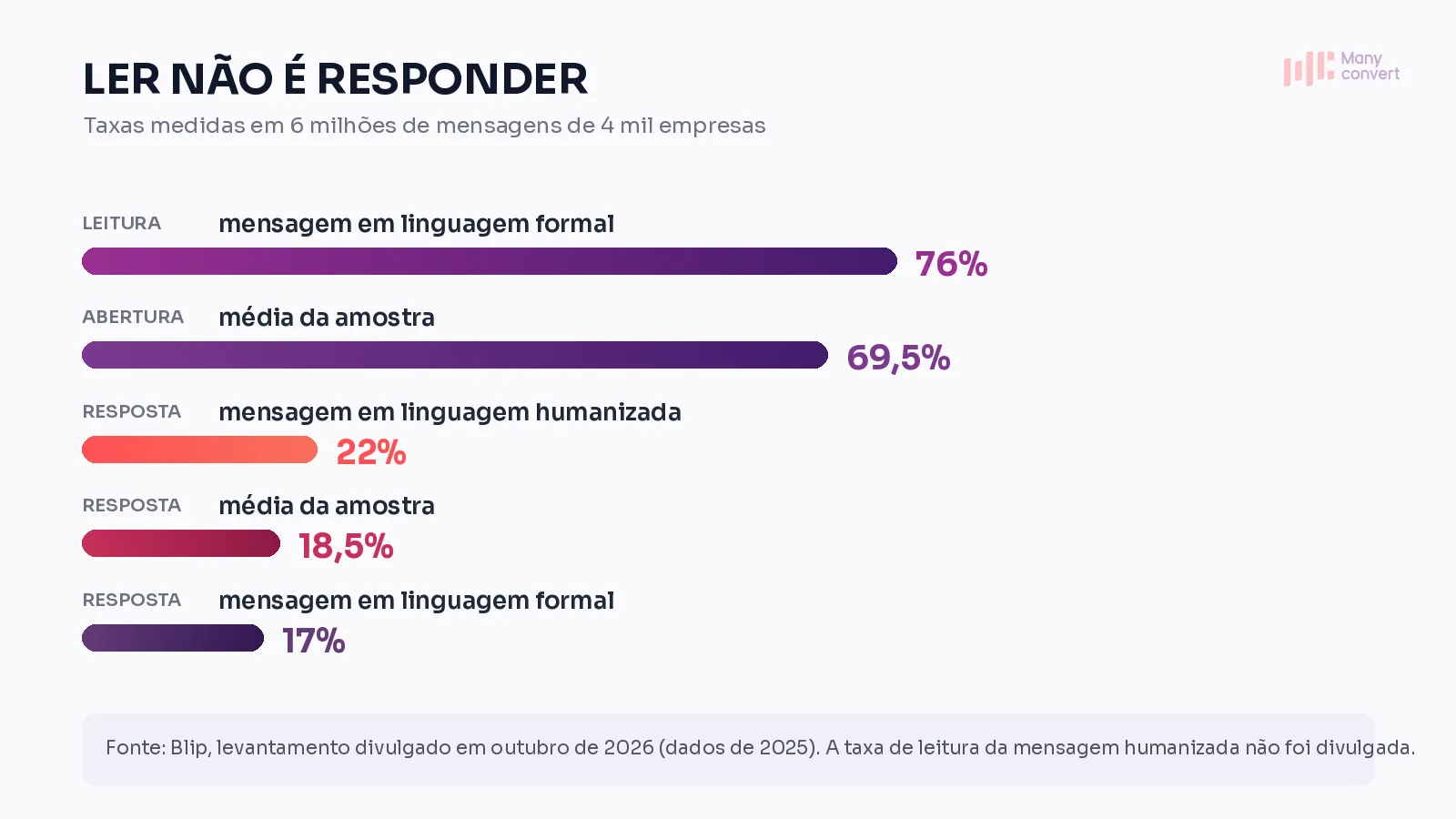
| Message format | Read rate | Reply rate | What retailers should take away |
|---|---|---|---|
| Notification and outbound broadcast (sample average) | 69.5% | 18.5% | the channel delivers, but does not converse |
| Formal tone (95% of sends) | 76% | 17% | informs well, invites poorly |
| Humanized tone (5% of sends) | not disclosed | 22% | tone matters more than polished copy |
| Document + link, instead of standalone link | not disclosed | 2.4x more replies | context starts conversations |
_Source: Blip, survey released in October 2026 (4,000 companies, 6 million messages, 2025 data)._
The takeaway is straightforward. The message your store launches on November 27 must fit four pieces of info and one question: the item, the price, the delivery timeline, and what the customer gains by replying right now. Without the question, it is an alert. With the question, it is a conversation, and conversations have someone on the other end to keep things moving.
Where Conversations Turn into Sales: The Ri Happy Case Study
Ri Happy is the clearest example in 2026 that the problem is not the channel, it is the execution. The toy retail chain handled WhatsApp using store associates: a smartphone on the store counter, only monitored when someone was free and during business hours. Omnichat CEO Mauricio Trezub described the scenario to Mobile Time on October 16, 2026.
“It was a smartphone sitting on the store counter. You needed an associate who was free and willing to respond. And the interaction had to happen during business hours, when the store was open.” – Mauricio Trezub, CEO of Omnichat, to Mobile Time, 2026
After deploying an AI sales agent, channel conversion jumped from 4% to 70%. Omnichat itself notes that 70% is an outlier: among its client base, top performers hover around 25%. The driver behind that high figure is product context. Anyone reaching out to a toy store online wants to secure a birthday gift, and they want it solved immediately.
The invisible effort went into the catalog. Managing around 10,000 SKUs, Omnichat spent three months training the agent. Much of the product data was poorly structured and had to be enriched via suppliers so the agent could recommend accurately. Without a clean catalog, sales AI just turns into a generic response generator.
What your store should replicate is not the AI agent itself, but the sequence of operations. First, support needs to know what is being sold: name, size, stock, and delivery time. Only then should conversations be automated. Stores that reverse this order buy software and keep the exact same bottleneck, except now they pay per message.
The 4 Flows You Still Have Time to Launch Before November 27
You will not rebuild your entire operation in 11 days. But you can launch four automated flows, none of which require hiring new staff:
- Back-in-stock and offer alerts for shoppers who requested them. Anyone who clicked “notify me” or lingered on a specific product page receives a message featuring the item’s name, price, and release date. This is the warmest list available on the eve of the event, yet rarely segmented.
- Context-rich abandoned carts. The message names the product, the order value, and addresses the likely objection (shipping, coupon, delivery date). On Black Friday, this needs to trigger within hours, not days: competitors are showing the same product minutes away.
- Unpaid Pix / pending payments. The window is tight. A reminder between 30 minutes and 2 hours catches the buyer while intent is still high; waiting 24 hours turns it into annoying debt collection.
- Immediate post-purchase. Order confirmation, delivery timeline, and a relevant recommendation that pairs with what they just bought. This is the flow that turns the November spike into repeat revenue in January.
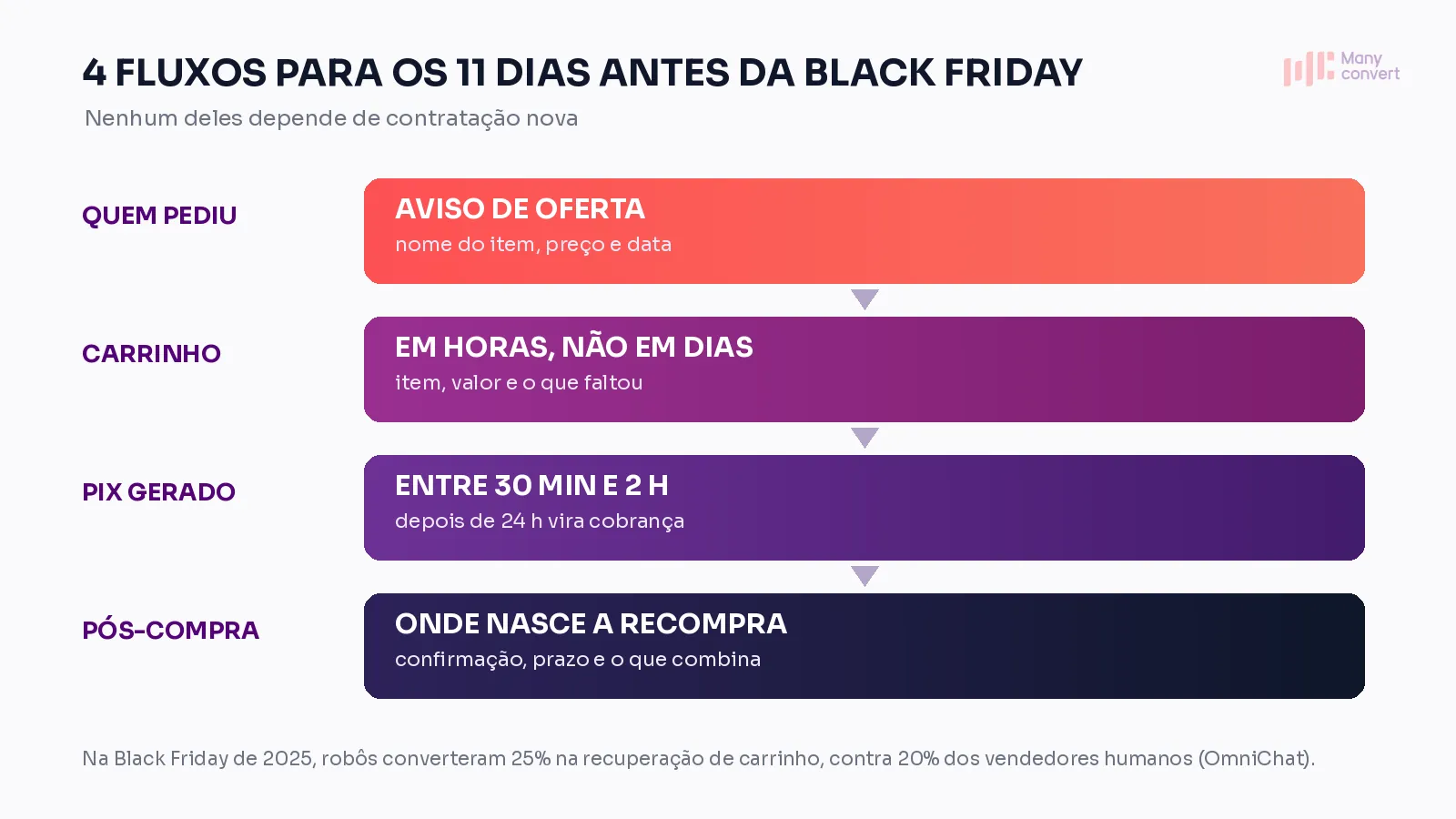
When it comes to automation across these flows, consider this: during Black Friday 2025, OmniChat’s sales bots converted at 25% in cart recovery campaigns, compared to 20% by human agents. In overall conversion, both tied at 12%. Average order value for human sales reps remained higher, US$ 857 versus US$ 640, which points to the right strategic split: bots recover volume, humans negotiate high-ticket value.
How to Know If WhatsApp Actually Sold or Just Sent Alerts
After November 27, four metrics will show whether the channel drove revenue or simply made noise:
- Reply rate by template. If a message has a 70% read rate and an 8% reply rate, the problem is your copy, not your audience list.
- Conversations converted into orders. Benchmarking started conversations against paid orders identifies exactly where drop-offs happen.
- Cost per conversation and cost per sale. At US$ 0.035 per delivered message, a 50,000-message blast costs US$ 1,750 before generating a single dollar in revenue.
- Time to first response. During Black Friday 2025, average customer wait times dropped 52%, from 2.34 to 1.07 minutes, according to OmniChat. Responding in minutes drives sales; responding in hours just handles tickets.
The 11 Days Left Are Worth More Than the Entire Week
The math is uncomfortable, but simple. If 98% of what your store sends today is alerts, Black Friday will just be the day your list receives another blast. Shoppers with high purchase intent are on their phones right now, comparing prices and checking if orders arrive before Christmas. Whoever is on the other side of that conversation wins the sale.
You do not need sophisticated AI to start. You just need to stop treating WhatsApp like a bulletin board and start running it like a checkout counter: with names, items, prices, shipping times, and a clear question at the end.
ManyConvert organizes your customer base by buying behavior and triggers cart recovery, unpaid order reminders, and repurchase flows via WhatsApp, combining AI and human reps on the same number. Each flow tracks sent messages, opened conversations, and closed revenue, so you know where to double down.
Talk to a ManyConvert specialist and launch at least one revenue-generating flow before November 27.