


Since October 2026, Meta has been testing a dynamic pricing model for WhatsApp marketing messages in Brazil. According to the rate card published by Mobile Time on October 29, a marketing message costs US$ 0.3217 in the country, compared to US$ 0.035 for utility and authentication categories. The tool is called Max Price: you set the maximum price you are willing to pay, Meta calculates the cost case by case, and only delivers the message if the price fits within your limit. The model is currently optional and becomes mandatory in the second quarter of 2027.
Until now, having a customer’s phone number in your CRM meant guaranteed access to them. Starting next year, it means having the right to place a bid. A broadcast sent to 40,000 contacts on a Tuesday morning will now compete with every other store vying for the exact same attention window. Those who do not know the value of their own customers will overpay for non-buyers and underinvest in those ready to purchase again.
This article explains how the maximum price works in practice, why reactivating an inactive customer is never worth the same as driving a repurchase from an active one, and how to calculate and set price caps for each customer segment.
What Changes with Max Price
Today, WhatsApp charges by message category, using a fixed rate card. Marketing is the most expensive category: US$ 0.3217 per message sent in Brazil. Utility and authentication cost US$ 0.035. A repurchase offer costs roughly nine times as much as an order update. Meta’s billing model had already changed on October 1, 2026, as we covered in our post on the new WhatsApp API pricing.
Max Price breaks away from standard rate cards. Instead of paying a flat rate every time, you set the maximum price you are willing to pay per message. Meta calculates the value of each delivery based on several factors and only delivers it if the calculated cost is within your limit. If market competition surges during that window and pushes the price above your cap, the message is not delivered.
In practice, the marketing template becomes ad space. As Pietro Bujaldon, CEO and founder of smarters, a BSP operating in the Brazilian market, put it: “the marketing template is increasingly becoming a media asset rather than a messaging asset” (Mobile Time, October 2026).
Sinch, another BSP operating in the country, has already adapted its platform for this model. The company outlines three primary use cases: prioritizing high-value customers with higher price caps during peak hours, reducing costs when the market average price drops, and running lower-cost campaigns for inactive users.
The third use case is what matters most to e-commerce operators. Dynamic pricing is not just about spending less. It is about spending differently, because every outbound message now carries an explicit opportunity cost.
Why the Same Message Carries Different Values
A repurchase message to someone who bought last month and a reactivation message to someone inactive for a year use the same channel, template, and rate card cost. The expected return, however, is completely different.
A customer who purchased 20 days ago has already proven they trust your store, completed checkout, and received the product. Their probability of buying again is high; the message only needs to remind them of a decision they already made. Someone who has not purchased in 14 months must first be convinced your brand still exists.
Paying the same for both messages is the mistake that flat-rate pricing was hiding. With dynamic price caps, that mistake directly impacts your bottom line.
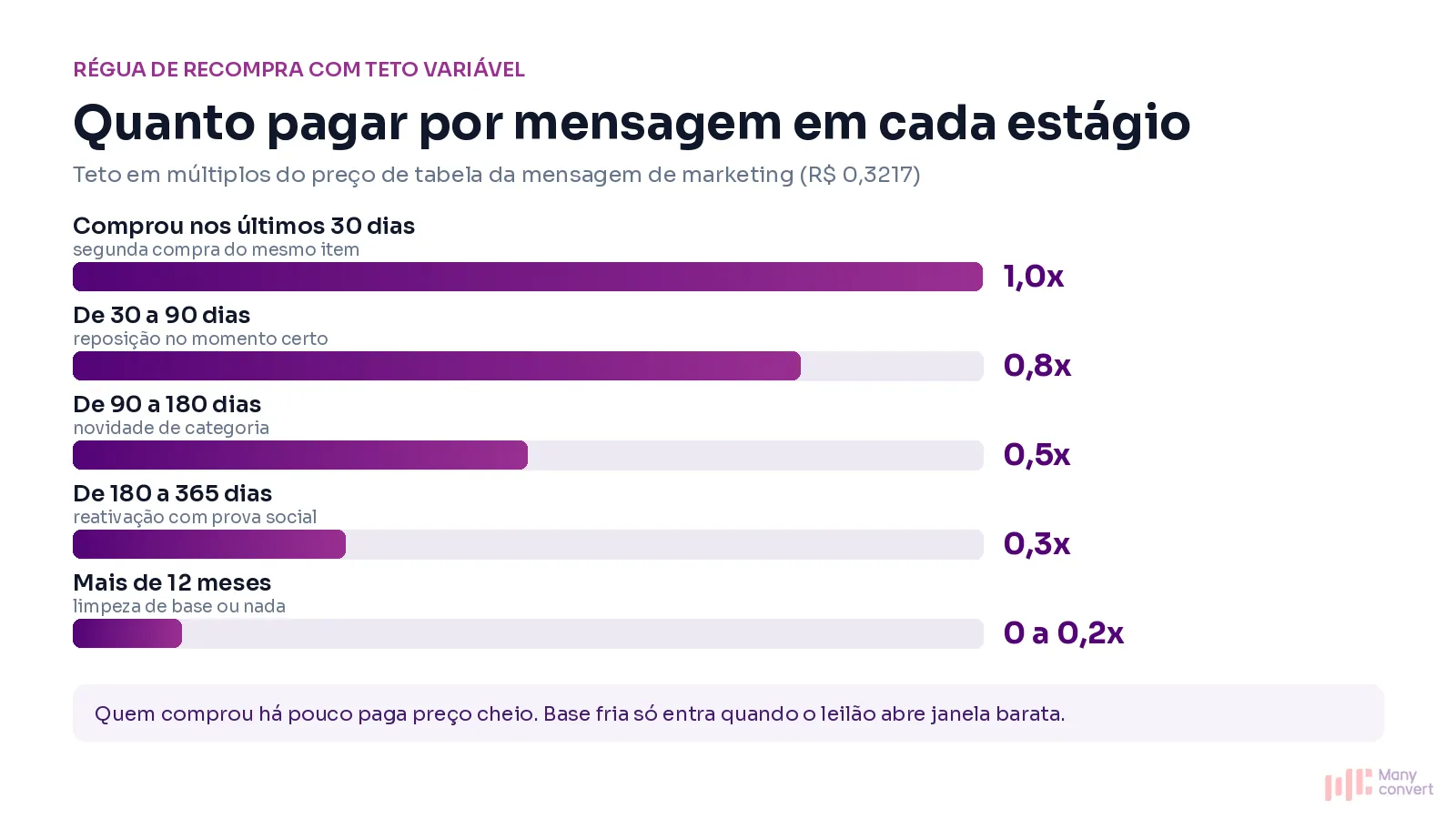
The framework I’d use has five tiers, measured as multiples of the base rate card price:
| Customer stage | Available signal | What the message must solve | Suggested cap |
|---|---|---|---|
| Purchased in the last 30 days | last purchase date | repeat purchase of the same item or complementary cross-sell | 1.0x |
| 30 to 90 days | estimated replenishment cycle | timely replenishment | 0.8x |
| 90 to 180 days | purchase frequency dropped | new arrivals in categories they previously bought | 0.5x |
| 180 to 365 days | zero interaction | winback with social proof and free shipping | 0.3x |
| Over 12 months | cold lead | list hygiene or nothing | 0 to 0.2x |
A multiplier of 1.0x means paying the full rate card price. A 0.3x cap means only bidding on windows where Meta calculates lower pricing. In either scenario, the decision is yours, and it must be established before sending, not mid-campaign.
How Much a Repurchase Message Is Worth
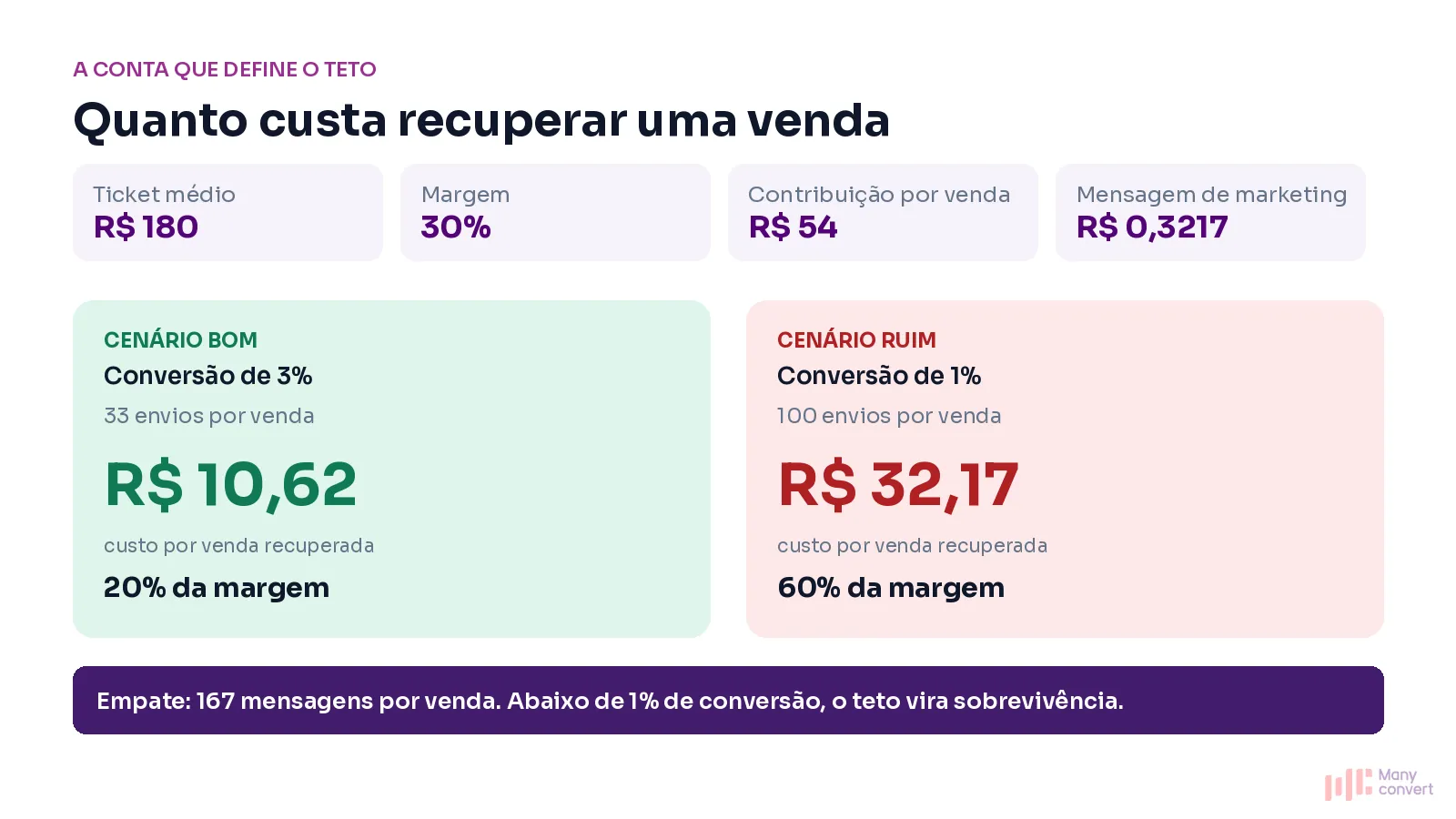
The calculation starts with your average order value (AOV). If your AOV is US$ 180 and your gross margin is 30%, each sale generates US$ 54 in contribution margin. At US$ 0.3217 per message, you can send up to 167 messages per recovered sale and still break even. That sounds comfortable until you examine conversion rates across different segments.
A repurchase workflow converting at 3% requires 33 sends per sale. That results in a cost of US$ 10.62 per sale, or 20% of your margin. At a 1% conversion rate, that cost climbs to US$ 32.17, consuming 60% of your contribution margin. This is where setting a price cap matters more than the nominal message price.
What changes the equation is channel performance history. Asics runs its official WhatsApp channel with conversion rates four times higher than its standard e-commerce site, an AOV twice as high, and a repurchase rate around 30%. WhatsApp accounts for 65% of the brand’s omnichannel revenue in Brazil, according to figures shared by OmniChat with Mobile Time in March 2026.
Notice what these figures indicate. A 30% repurchase rate is not driven by discounts. It is the result of continuous conversation combining sales reps and AI agents on the same number. When message costs are dynamic, this operational model yields a two-fold advantage: it converts better and can bid less per delivery, as historical engagement influences Meta’s pricing algorithm.
How to Adjust Your Repurchase Workflow in 5 Steps
This is an operational shift you can execute well before 2027. Following these steps in order prevents redundant work.
- Segment your database by purchase stage. Do not segment by generic marketing tags, but by days since last purchase and product consumption cycles. Without this data in your CRM, price caps cannot function properly.
- Calculate contribution margin per sale for each cohort. AOV multiplied by margin. This metric determines the maximum you can pay per message at each stage.
- Measure real conversion rates for each cohort by channel. Repurchase, reactivation, and abandoned carts deliver vastly different conversion benchmarks. Relying on an overall average to set price caps will inevitably drive up costs.
- Define price caps by cohort and delivery window. Establish your multiplier before launching campaigns and document the rules. Peak hours cost more and are rarely optimal for engaging inactive customers.
- Run a pilot with low price caps on cold segments. Prioritize deliveries to contacts with the highest purchase intent, monitor how many messages were skipped due to pricing limits, and calibrate accordingly.
Evaluating the pilot is straightforward. If high-intent messages are being blocked, your price cap is too low and you are sacrificing sales. If cold audiences are burning budget with near-zero conversions, your price cap is set too high.
4 Costly Mistakes to Avoid in 2027
The costliest mistake is maintaining a one-size-fits-all workflow across your entire database. Blasting the same message to a customer who bought 15 days ago and one who bought two years ago is already expensive under fixed pricing. In an auction model, you pay twice: once on wasted ad spend, and again on forfeited sales.
Another common error is using marketing templates for utility messaging. Order status, payment confirmations, and shipping alerts cost US$ 0.035. If your operations dispatch these as marketing messages, each notification costs nine times more than necessary. Review and align template categories inside WhatsApp Business Manager.
The third mistake is selecting channels out of habit rather than cost-efficiency. Email is still practically free and converts worse; WhatsApp converts better and costs more. The right call aligns channel with customer lifecycle: repeat buyers engage readily on WhatsApp, whereas someone who has never opened your messages is not going to open the tenth one.
And fourth, the most common pitfall: buying lists or acquiring new leads to offset stagnant retention. With dynamic message pricing, working your existing customer base remains far cheaper than buying acquisition again. Brands entering 2027 without structured repurchase workflows will end up subsidizing their competitors’ auction bids.
The Future Is an Auction. Do You Know What Your Customer Is Worth?
Fixed rates provided a comfortable cushion because no bidding decisions were required: the price was identical across the board. Max Price eliminates that cushion and forces the question every e-commerce executive should know by heart: what is your customer’s next purchase actually worth?
Those with clear answers can set calculated price caps, eliminate wasted spend across inactive contacts, and bid aggressively to reach active buyers. Those without them will discover their customer lifetime value the hard way, line by line on their WhatsApp invoice.
ManyConvert organizes your audience by purchase behavior (recency, replenishment cycle, abandoned carts, unpaid orders) and triggers WhatsApp repurchase flows combining AI and human reps on the same number. Every flow reports messages sent, conversations initiated, and sales closed, showing you exactly where to raise your price caps.
Talk to a ManyConvert specialist and build a repurchase framework with segment-level price caps before dynamic pricing becomes mandatory.