



In the hyper-competitive e-commerce landscape of 2026, the perception of customer support has undergone a radical transformation. Once seen exclusively as a channel for resolving customer questions and issues, traditional customer support has evolved into the primary driver of conversion and retention online. At the center of this revolution is a tool already woven into the daily routines of billions of people: WhatsApp.
For e-commerce founders and marketing agencies looking to scale operations sustainably, understanding the current dynamics of WhatsApp support is no longer just a competitive edge; it is a survival requirement. Consumers no longer have the patience to open email tickets, wait days for a reply, or spend minutes waiting on website live chats. They demand immediacy, personalization, and convenience in the palm of their hands. And they are willing to financially reward brands that deliver this experience.
In this article, I will cover strategies, metrics, and methodologies defining the state of the art in WhatsApp support for modern e-commerce, turning conversations into measurable and predictable revenue.
The End of Traditional Customer Support and the Rise of Consultative Service
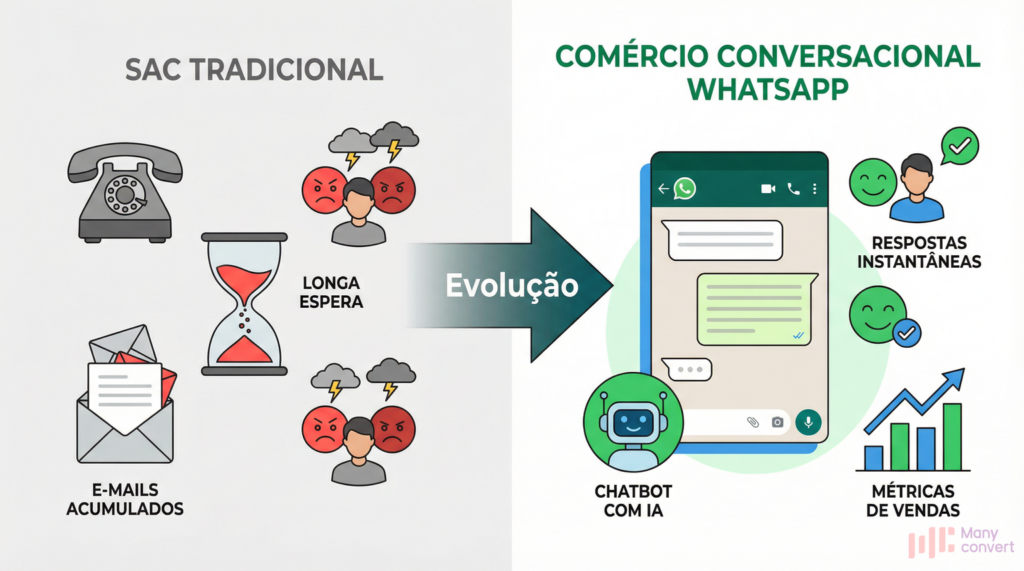
The first major shift we see across the e-commerce ecosystem is the transition from reactive support to consultative and proactive service. Historically, support teams were only contacted when something went wrong: a delivery delay, a defective product, or a refund request. The goal was to minimize contact time and close the ticket as quickly as possible.
Today, the dynamics are completely different. WhatsApp support operates across every stage of the customer journey, from discovery to post-purchase. The channel has become an environment where pre-purchase questions are answered in real time, objections are handled with empathy, and personalized recommendations are made via WhatsApp based on customer context.
Recent data on consumer behavior in 2026 confirms this shift. Engagement in instant messaging channels reaches open rates that frequently exceed 80%, a stark contrast to the traditional 15% to 20% of email marketing. More importantly, conversion rates in WhatsApp interactions are substantially higher. When a customer starts a conversation to ask a question about a product and receives consultative, humanized service, the likelihood of completing the purchase increases exponentially.
The Psychology Behind Conversational Commerce
To understand why WhatsApp is so effective as a sales tool disguised as customer service, we need to analyze consumer psychology. The WhatsApp environment is inherently intimate. It is the same app where people chat with friends, family, and coworkers. When a brand is invited into this space, it breaks through the institutional barrier typical of a traditional website or formal email.
This proximity builds a level of trust that is hard to replicate in other channels. Customers feel they are talking to a real person (even when the initial interaction is handled by well-configured artificial intelligence), rather than browsing a static catalog. Cognitive friction decreases, and decision-making is streamlined through direct assistance.
Structuring a High-Performance Support Operation
Turning WhatsApp into a profitable channel requires more than simply placing a phone number in your website footer. It requires a robust technological infrastructure and a results-driven team management methodology. Below, we break down the fundamental pillars for structuring a high-performance operation.
1. Adopting the WhatsApp Business API
The first and most critical step is transitioning from the standard WhatsApp Business app to the WhatsApp Business API. While the free app is suitable for micro-businesses, it quickly turns into an operational bottleneck as ticket volume grows. Limited connected devices and the lack of advanced automation and integration capabilities make it impossible to scale support with quality.
The API, on the other hand, was built specifically for operations at scale. It allows multiple agents to use the same number simultaneously, routing conversations intelligently. Furthermore, the API is key to integrating WhatsApp into your e-commerce tech stack, connecting the messaging channel to your ERP, e-commerce platform, and logistics systems.
| Operational Feature | Standard Business App | WhatsApp Business API | Impact on E-commerce |
|---|---|---|---|
| Simultaneous Access | Limited (1 phone + 4 PCs) | Unlimited | Enables support team scaling without creating bottlenecks. |
| Data Integration | None | Full (ERP, E-commerce, CRM) | Agents have the customer’s full history on screen. |
| Advanced Automation | Quick replies only | AI chatbots and complex workflows | Resolves common questions automatically, freeing up the team. |
| Metrics and Reporting | Basic (sent/read) | Granular (response time, CSAT) | Enables data-driven management and continuous optimization. |
2. Intelligent Triage and Tier-1 Automation
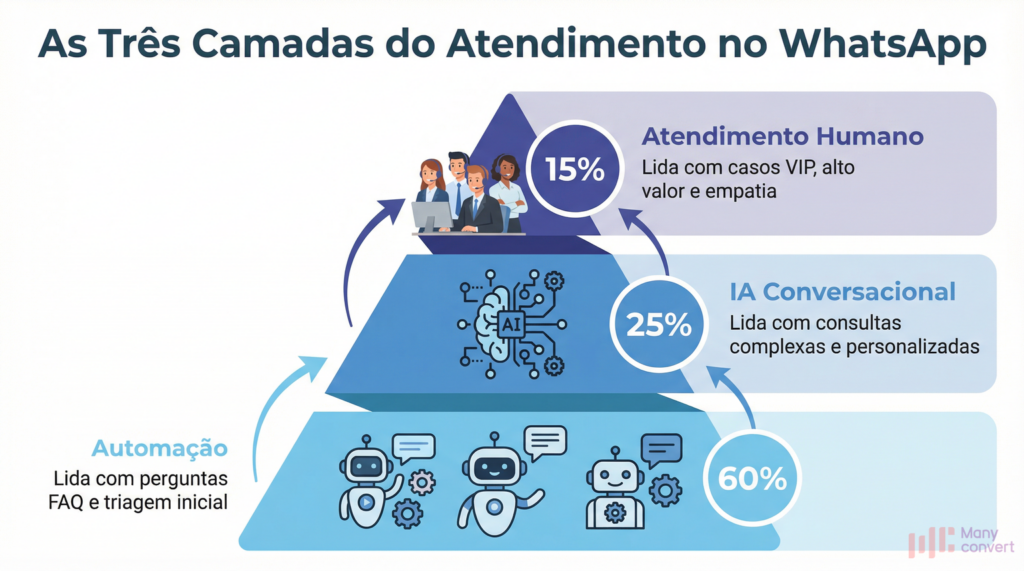
One of the biggest mistakes e-commerce brands make when scaling customer service is attempting to humanize 100% of interactions. The reality is that a significant share of inquiries (often between 40% and 60%) consists of repetitive, low-complexity questions: “What is my order status?”, “Do you deliver to my zip code?”, “How does your return policy work?”.
Allocating human agent time to answer these questions is a waste of valuable resources. Modern operations leverage intelligent automation and conversational AI to perform initial triage and resolve Tier-1 requests instantly.
When a customer asks for order tracking, a virtual agent integrated with the e-commerce platform can identify them by their phone number, check the status in the system, and provide an answer in seconds, 24/7. The human team steps in only when the complexity of the request requires empathy, negotiation, or handling non-standard issues.
3. Empowering the Team with Context
When an interaction is handed off to a human agent, the quality of support depends directly on the context available to that specialist. Modern consumers hate repeating information. If they already provided their order number to the chatbot, or if they are a returning customer who bought three times in the past year, the agent needs this information on screen before sending the first message.
Integrated customer service platforms provide a unified dashboard where the agent sees not only the conversation, but complete purchase history, average order value, recently viewed products, and past interactions. This depth of context makes support truly personalized. The agent stops being a mere “ticket resolver” and becomes a sales and customer success consultant.
Metrics That Matter: Measuring Support Success
Professionalizing WhatsApp customer service demands a shift in how success is measured. Traditional call center metrics still have their place, but they must be complemented by indicators tracking sales impact and deep customer satisfaction.
First Response Time (FRT)
On WhatsApp, expectations of immediacy are exceptionally high. An email can be answered within 24 hours; a WhatsApp message demands a reply within minutes. First Response Time measures how long it takes for a customer to receive initial contact (whether from a human or an efficient virtual agent) after starting a conversation. Keeping this metric in minutes (or seconds, with automation) is vital to prevent frustration and cart abandonment.
First Contact Resolution (FCR)
This metric tracks the percentage of support requests resolved in the very first interaction, without requiring complex handoffs or follow-up contacts. A high FCR indicates that the team (and automation) is well trained, equipped with the right tools, and empowered to resolve customer problems efficiently.
Customer Satisfaction Score (CSAT) and Net Promoter Score (NPS) in Channel
Evaluating customer satisfaction immediately after an interaction is crucial. Sending a quick, simple survey (such as a 1-to-5 star rating) directly within WhatsApp delivers response rates far superior to email surveys. Monitoring WhatsApp-specific CSAT allows you to spot operational bottlenecks and team training opportunities.
Support-Influenced Revenue
This is the metric that turns customer support from a cost center into a profit center. Through proper link tagging and customer journey tracking, you can measure how many sales were closed during or immediately after a support interaction. When e-commerce leadership realizes that the support team generates, for example, 15% of total store revenue through consultative assistance and upselling, investments in technology and training become much easier to justify.
Actionable Strategies to Drive Sales via Customer Support
With infrastructure and metrics in place, how can the support team actively drive revenue? The key lies in spotting natural sales opportunities that emerge during support conversations.
The Power of Contextual Cross-Selling
Unlike a generic website pop-up suggesting “related products”, a recommendation made by a human agent during a conversation carries far more weight. If a customer reaches out with questions about hiking boot sizing, the agent resolving the question can naturally add: “By the way, for this boot model, we highly recommend our thermal hiking socks, which prevent blisters on long hikes. Would you like me to add a pair to your cart?”. This consultative approach delivers extraordinary conversion rates because it feels like genuine help, not advertising.
Active Recovery of Lost Sales
Customer support does not have to be merely reactive. High-performing teams leverage WhatsApp to actively reach out to shoppers showing high purchase intent who did not complete their orders. This goes far beyond automated abandoned cart reminders.
When a high-ticket order is declined by the credit card processor, for instance, a fast, human, empathetic message from the support team can save the sale. The message should not feel like a collections notice, but an offer to help: “Hi, [Name]! We noticed an issue while processing your order. To make sure you do not miss this offer, would you like me to generate an alternative payment link or a Pix with a discount?”. This proactive approach demonstrates care and recovers significant revenue that would otherwise be lost.
Customer Service as a Retention Engine
The post-purchase experience is the primary driver of repeat purchases. WhatsApp support shines here by keeping customers informed transparently. Proactively sending delivery updates, onboarding guides for newly arrived items, and check-in messages (“Did your order arrive safely? How do you like the quality?”) establishes long-term relationships.
A customer who encountered a delivery issue but received fast, transparent, and effective support on WhatsApp often becomes more loyal to the brand than one who never had an issue at all. How a company handles friction is the true test of trust.
Conclusion: The Future Is Conversational
The evolution of customer support in e-commerce is undeniable. The legacy model, built on sluggish contact forms and impersonal interactions, is rapidly being replaced by fluid, instant, and context-rich conversational experiences.
Brands that master the art of pairing intelligent automation with the empathy of skilled human support will not only cut operational costs, but also build a formidable competitive moat. In a market where products and pricing are increasingly commoditized, the customer service experience becomes the primary differentiator.
WhatsApp is not merely a messaging app; it is the new storefront, the new support desk, and the new sales channel for modern e-commerce. Investing in the professionalization of this channel is an investment in the sustainable growth and long-term profitability of your business.
Ready to turn your store’s WhatsApp into a sales and retention machine?
ManyConvert is the complete conversational platform that combines Artificial Intelligence and humanized support to scale your e-commerce results. Manage multiple conversations, recover sales, and delight your customers with a platform 100% integrated with your online store. Request a Demo