



For many, WhatsApp is still synonymous with chatting with friends and family. But for e-commerce brands, that idea is long gone. In 2026, the app established itself as one of the most powerful sales and relationship channels on the planet. With an open rate near 98% and over 175 million daily conversations between users and businesses, ignoring the potential of WhatsApp is no longer an option; it is a costly decision that leaves an immense amount of money on the table.
In this guide, we dive into the structure of a high-performance WhatsApp customer service operation. The goal is not just to teach you how to reply to messages, but to build a system that delights customers, resolves issues efficiently, and, above all, becomes a sustainable growth engine for your business.
The Conversational Commerce Era: Why Is WhatsApp Indispensable?
We are experiencing the rise of conversational commerce, an approach that puts dialogue at the center of the buying experience. Modern consumers, especially in Brazil, no longer want to be mere spectators on a website. They look for interaction, personalization, and the convenience of resolving everything in one place. And that place is increasingly WhatsApp.
Global statistics confirm this shift in behavior. The conversational commerce market, which already drives over $12 billion, has an explosive growth projection, potentially reaching $32.6 billion by 2035. Even more importantly, 66% of buyers say they prefer interacting with brands via chat rather than browsing traditional websites. The logic is simple: dialogue removes friction, builds trust, and accelerates buying decisions. Proof of this is that 75% of customers who start a conversation with a business to ask questions about a product end up making a purchase.
| Impact Metric | Statistic | E-commerce Implication |
|---|---|---|
| Open Rate | 98% | Your messages get seen, unlike emails lost in cluttered inboxes. |
| Click-Through Rate (CTR) | 45-60% | Engagement is exceptionally high, driving qualified traffic to your offers. |
| Consumer Preference | 72.4% | Customers are more likely to buy from brands offering conversational support. |
| Post-Contact Conversion | 75% | A well-handled conversation is a direct path to a new sale. |
The Operational Foundation: WhatsApp Business API vs. Standard App
The first step toward professionalizing your operation is understanding the tool. Many e-commerce stores start with the free WhatsApp Business app, but quickly hit roadblocks. For an operation aiming to scale, the only viable solution is the WhatsApp Business Platform (API).
The API is the infrastructure that allows businesses to build robust solutions on top of WhatsApp, going far beyond what the standard app offers. The main difference is that the API does not have its own interface; it must be connected to a customer service platform like ManyConvert.
Comparison: Business App vs. API
| Feature | WhatsApp Business App | WhatsApp Business API (with Platform) |
|---|---|---|
| Number of Agents | 1 mobile user at a time + 4 on desktop | Unlimited, with multiple agents on the same number |
| Automation | Basic quick replies and away messages | Complex chatbots, AI Agents, automated workflows |
| Integrations | None | Full integration with CRM, ERP, and e-commerce platforms |
| Metrics | Very basic statistics (messages sent/delivered) | Comprehensive performance analytics for teams and workflows |
| Scalability | Low, ideal for micro-businesses | Extremely high, designed for mid-market and high volume |
To use the API, companies need a Business Solution Provider (BSP), official Meta partners authorized to grant access to the platform. ManyConvert acts as this bridge, delivering not only API access, but the entire software layer required to manage conversations, automations, and integrations intuitively.
The Three-Tier Architecture to Scale Without Sacrificing Quality
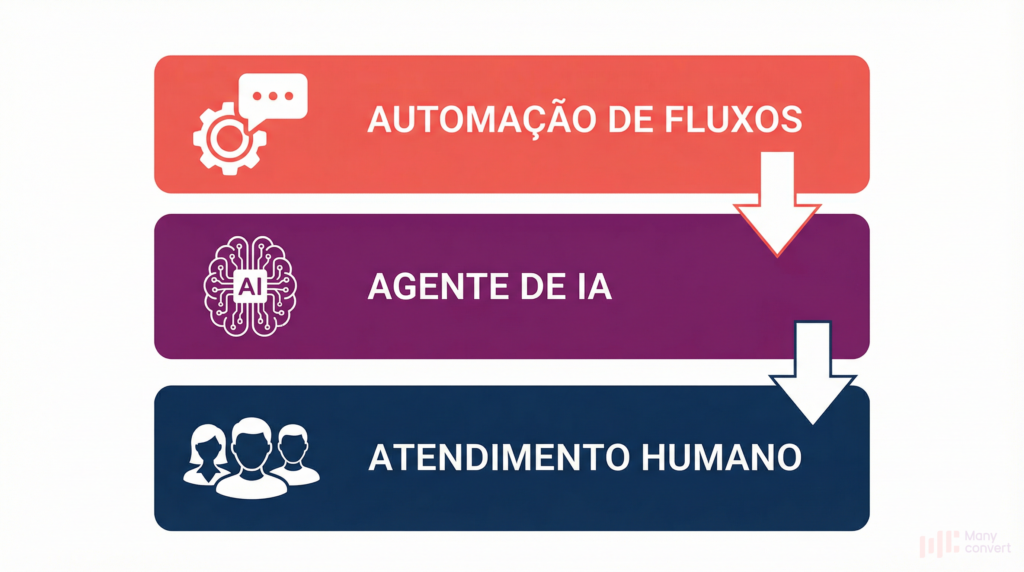
Scaling WhatsApp customer support does not simply mean hiring more agents. It means building an intelligent architecture combining three complementary tiers. It is estimated that between 60% and 70% of inbound WhatsApp interactions in e-commerce are repetitive and predictable questions: “What is the delivery time?”, “Can I pay in installments?”, “How do returns work?”. These inquiries do not need, and should not, be answered manually by a human.
- Tier 1 — Repetitive Workflow Automation: Automated flows that deliver the right answer in seconds, 24/7. This frees up human teams and ensures consistent answers.
- Tier 2 — Conversational AI Agent: Goes beyond traditional chatbots. It understands natural language, interprets context, and conducts complex conversations smoothly. Integrated with your e-commerce platform, it checks inventory, looks up delivery dates by order number or tax ID, and processes returns autonomously.
- Tier 3 — Specialized Human Support: With the previous tiers properly deployed, human agents handle only situations requiring empathy, judgment, and negotiation skills, dealing with higher-value cases.
Structuring Your Support Team for Success
With technology as your backbone, the next pillar is people. Instead of running a generic support team, consider role specialization to drive efficiency:
- Pre-Sales Team: Product specialists. Their focus is strictly consultative: answering questions about specifications, helping compare items, clarifying store policies, and subtly guiding the buyer toward the best decision.
- Customer Success Team (Post-Sales): These agents take over after checkout. Their mission is to guarantee a seamless post-purchase experience. They resolve shipping issues, exchanges, returns, and complaints, turning potential friction into loyalty opportunities.
- Recovery Squad (Outbound Sales): An incentive-driven team focused solely on recovering lost revenue. They work on abandoned carts and unpaid Boleto/Pix checkouts, leveraging negotiation techniques and mental triggers to convince shoppers to complete their purchase.
Smart Automation: The Key to Scaling with Quality
Automation allows your operations to scale without headcount costs skyrocketing. Using the WhatsApp API alongside a platform like ManyConvert, you can deploy sophisticated automation workflows that run 24/7:
- AI Agent for Triage and FAQs: Set up an Artificial Intelligence agent as the front line of your customer service. It greets buyers, understands initial intent, and answers common questions, filtering inquiries and freeing human staff for scenarios that require a personal touch.
- Proactive Transactional Notifications: Keep customers informed at every stage. Build automations to send payment confirmations, order preparation updates, invoice issuance notices, dispatch confirmations with tracking links, and delivery notices. This drastically reduces customer anxiety and support volume asking “Where is my order?”.
- Cart Recovery: Minutes after a cart is abandoned, an automated message can be triggered offering assistance or a discount voucher. The AI can also analyze items in the cart to personalize the outreach.
Team and Technology: The Winning Formula

The biggest mistake e-commerce brands make when building their WhatsApp operations is treating technology and teams as separate silos. Exceptional results emerge only when both work in complete synergy. Technology without the right team creates cold, context-free replies. A team without the right technology drowns in volume and sacrifices quality.
Industry data reveals that consumers who receive a reply within 5 minutes are 21 times more likely to convert than those who wait longer than 30 minutes. That speed is only achievable when automation and AI manage initial volume while humans focus on high-impact interactions.
Metrics: The Control Panel for Your Success
Managing support without data is like flying an airplane blindfolded. The WhatsApp API, through platforms such as ManyConvert, provides an array of metrics to help you continually optimize performance:
- First Response Time (FRT): Tracks your team’s agility. A low FRT is crucial to customer satisfaction during initial contact.
- Average Handle Time (AHT): Reflects operational efficiency. Excessively high AHT often indicates confusing internal processes or training gaps.
- First Contact Resolution (FCR): One of the most important support metrics. A high FCR shows your team solves issues effectively and that automation flows are properly aligned.
- Customer Satisfaction (CSAT) and Net Promoter Score (NPS): Automated satisfaction surveys delivered right after an interaction concludes to gauge customer perception.
- WhatsApp Conversion Rate: The ultimate revenue metric. How many conversations resulted in sales? This measures direct ROI from the channel.
The Future Is Conversational. Are You Ready?
Building a WhatsApp customer service operation that scales sales is a strategic initiative combining technology, processes, and people. It is not just about having a presence on another channel; it is about weaving intelligent conversation throughout the entire customer journey. Meta updates for the WhatsApp API in 2026 further underline the necessity of reliable, up-to-date technology partners.
ManyConvert was founded at the forefront of this conversational revolution. Our platform simplifies the complexity of the WhatsApp API, providing an all-in-one solution with AI agents, marketing automation, and an intuitive helpdesk interface, fully integrated with your e-commerce ecosystem.
Do not let your competitors dominate the world’s fastest-growing sales channel. Click here, schedule a free ManyConvert demo, and discover how we can turn your conversations into conversions.